Wood, Craft & the Contemporary Home

The Wood That Already Knows What It Is

Indian heritage furniture — carved from teak, rosewood, mahogany, and mango wood — was never trying to look warm. The warmth was just the material doing what wood does. Here is why that matters now more than it has in thirty years.
Teak
Saagwan
Rosewood
Shisham / Sheesham
Mahogany
Mahogani
Mango Wood
Aam ki Lakdi

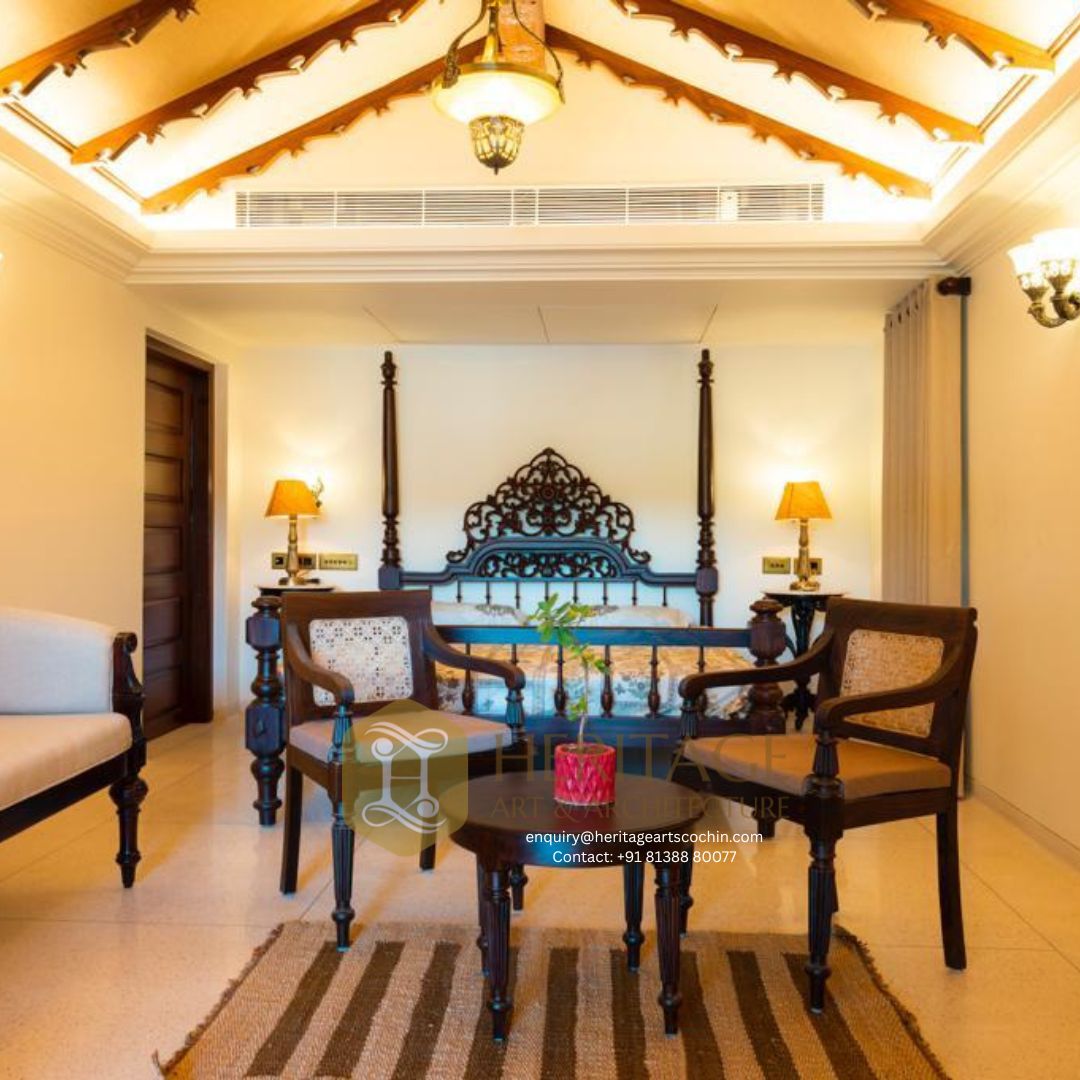
There is a particular kind of chair that appears in old photographs of Indian verandas — a low-slung piece with a cane seat, wide arms polished by decades of hands, and a frame turned from old-growth teak that has gone the colour of dark honey. Nobody chose that colour. The chair earned it. And in the context of contemporary interior design, where material honesty has become one of the most valued qualities a space can have, that chair now belongs in almost any room being built today.

Indian traditional furniture carries four things that modern manufacture has found very difficult to replicate: color that develops over time, carving that requires no apology, structural logic born from generations of craft knowledge, and the specific weight of wood that was grown slowly and cut once. This piece covers all four, working through each of the principal heritage species and the regional making traditions that shaped them.
Indian Craft Traditions

The Hands That Taught the Wood What Shape to Take

Indian furniture carving is not ornament applied to a functional object. In the furniture traditions of Gujarat, Rajasthan, Kashmir, and the Chettinad region of Tamil Nadu, the carving is structural logic made visible. The lattice panel that fills the back of a Sheesham chair is doing mechanical work — distributing load, managing wood movement, and providing visual rhythm — at the same time. Removing the carving would make the piece weaker, not simpler.
The scale of India's carving heritage is significant. The Saharanpur woodworking cluster in Uttar Pradesh — which has been producing carved teak and sheesham furniture for over two hundred years — employs, according to data from the Ministry of Textiles' Development Commissioner for Handicrafts (2021), approximately 150,000 craftspeople across its direct and ancillary units. Rajasthan's Barmer, Jodhpur, and Jaisalmer districts maintain parallel traditions in carved and turned furniture, historically using local softwoods but now predominantly working in seasoned sheesham and teak.

Jali Work

Geometric lattice carved through the full thickness of the panel. Found extensively in Rajasthani and Mughal-influenced furniture. The negative space is as considered as the solid wood.

Turned Legs & Columns

Lathe-turned elements in teak and sheesham define South Indian and colonial-era furniture. The bulbous profile of a Chettinad table leg is immediately readable as a regional signature.

Inlay & Marquetry

Rosewood inlaid with bone, brass wire, or lighter wood is characteristic of Mysore and Kerala traditions. The contrast between the dark ground and the inlay depends entirely on the depth of the rosewood's color.

The carving traditions are also what make these woods specifically legible as Indian pieces. A mass-produced sheesham table and a carved sheesham table share the same material and the same tonal palette — that deep honey brown with reddish undertones — but they represent entirely different propositions. The carved piece carries the evidence of the hand. It shows where a craftsperson made a decision about depth, about spacing, about the rhythm of a repeating motif. That evidence is part of what a buyer is acquiring when they choose a traditional carved piece over a contemporary reproduction.

A Saharanpur craftsperson working in sheesham does not carve the wood. They negotiate with it — following the grain through the motif, adjusting depth where a knot runs, letting the material’s own structure guide the final form.

The practical consequence for interiors is that carved Indian furniture reads differently in a room than European or East Asian woodwork does. European carving traditions tend toward symmetry and fixed botanical motifs. Indian carving carries more movement — the patterns rotate, mirror, expand, and contract across a surface in ways that repay extended looking. A carved Rajasthani cabinet door is not something you take in once and understand. The design reveals itself across weeks of daily looking.
Heritage Species & Their Palettes

Four Woods, Four Color Histories

Teak — Saagwan

Tectona grandis · Central & South India, Myanmar origin

New mill / pale gold
#E8C060
Honey amber
#C89030
Aged golden
#A07030
Deep cognac
#7A5020
Teak has been the prestige furniture wood of South and Central India for centuries, partly because of its color and partly because of what its natural silica and oil content does for its structural properties. The wood resists splitting in dry climates and does not swell dramatically during monsoon humidity cycles — a quality that made it the default choice for large pieces in colonial and pre-colonial Indian households. A Kerala teak harvest table built in the 1890s would have survived six or seven decades of high-humidity summers without significant checking or warping.
Its color moves from a bright gold-yellow at milling through a deepening amber over the first several years, settling into the rich honey tone that most people associate with it. The silica in the wood catches light differently than softer timbers do — teak in direct sunlight has a slight mineral sparkle that lacquered wood cannot replicate.

Indian Rosewood — Beete

Dalbergia latifolia · Western Ghats, Karnataka, Kerala, Tamil Nadu

Freshly worked / pink-tan
#B87858
Deep rose-red
#8C3A22
Purple-brown heartwood
#602010
Near-black ribbon figuring
#3A1208
Century-aged ebony depth
#180806
Dalbergia latifolia — Indian rosewood, known locally as Beete in Karnataka and Itti in Kerala — is among the most prized furniture timbers produced anywhere on the subcontinent. It grows primarily through the forests of the Western Ghats, across Karnataka, Kerala, and into Tamil Nadu, and has been the foundational material of South India's finest furniture for several centuries. Its interlocking grain, extreme density, and natural resistance to insects, moisture, and fungal decay made it the wood of choice for inlay work, turned legs, carved panels, and high-precision joinery across the courts and wealthy households of the Mysore, Travancore, and Vijayanagara kingdoms.
What separates Dalbergia latifolia from any other rosewood species available in the Indian market is its colour. The heartwood carries a deep, purple-toned red-brown — a tone that sits in an entirely distinct register from the warm honey-brown of teak or the orange-sienna of mahogany. The purple undertone is the signature: it is what gives Indian rosewood its particular visual weight, its ability to absorb and hold light rather than reflect it, and its dramatic response to oil finishing. A panel of true Indian rosewood, polished with linseed oil, does not gleam. It glows — the colour seems to come from inside the wood rather than from its surface.
The ribbon figuring that runs through well-selected Dalbergia latifolia — alternating bands of lighter and darker tone created by the interlocking grain's response to light — gives each piece a visual complexity that no stain or veneer replicates. A rosewood dining tabletop can show six or seven distinct tonal registers across the same surface, all within the deep red-purple family, all belonging completely to each other. Furniture makers in the Mysore and Kerala traditions learned to orient boards so the figuring ran in deliberate visual rhythm across a door panel or cabinet face. This was not a technical operation. It was composition.

Indian rosewood does not need to be made beautiful. It arrives that way. The craftsperson’s job is simply to not get in the way of what the wood is already doing.

True Dalbergia latifolia has been under pressure from over-harvesting and export restrictions since the 1970s, and the Indian government classifies it as a protected species under the Wildlife Protection Act. Commercial-grade Indian rosewood for furniture today comes almost entirely from sustainably managed plantations in Karnataka and Kerala, or from salvage — reclaimed structural members from demolished heritage buildings in the Western Ghats region, where old-growth rosewood was routinely used in house construction. Reclaimed rosewood from these sources is, in terms of grain density and colour depth, superior to plantation-grown wood by a considerable margin. The old-growth trees grew slowly over a century or more; that slow growth is written in the grain spacing and in the concentration of the natural resins that give the wood its colour. A reclaimed rosewood beam from a 19th-century Karnataka farmhouse contains material qualities that no tree currently growing will match for another hundred years.
In the context of inlay work — for which Indian rosewood is particularly valued — the wood's density and stability are as important as its colour. Brass wire inlay, bone inlay, and lighter wood marquetry all depend on a ground material that will not move, shrink, or swell differentially with the inlay material. Rosewood's dimensional stability under humidity variation is exceptional, which is why the Mysore and Thanjavur inlay traditions built their finest work on a rosewood ground. The inlay has survived intact across centuries in the humidity of the South Indian coast because the ground material held.

Mahogany — Mahogani / Burma Teak

Swietenia macrophylla / Toona ciliata · South & Northeast India

Young / pale sienna
#D08060
Classic warm red
#B85830
Rich terracotta
#8A3C20
Dark aged brown
#601E10
In India, the term "mahogany" covers multiple species depending on region. Toona ciliata — Indian mahogany or toon — grows through the Himalayan foothills and Northeast India and has been used in quality furniture since at least the nineteenth century. Its color range, a warm red-sienna that deepens considerably with age, sits close to imported Swietenia mahogany and is often used interchangeably in the Indian furniture trade.
What distinguishes mahogany from other heritage species is how dramatically it darkens over decades. A piece that arrives at a light reddish-brown in year one will, by year twenty, have moved into the deep, complex mahogany tone associated with antique colonial furniture. This is not degradation — it is the material's full color arriving. South Indian homes with inherited mahogany dining furniture typically contain pieces with a depth of color that no new piece can match and no stain can convincingly simulate.

Mango Wood — Aam ki Lakdi

Mangifera indica · Pan-India

Gold-honey
#D8A860
Warm peach-brown
#C49070
Olive-grey streak
#8A9070
Dark mineral
#383020
Mango wood has always been worked in India — a country with hundreds of millions of mango trees could hardly ignore the timber — but it occupied a different status from teak or sheesham. Considered a utility wood, it was used for agricultural implements, packing crates, and modest household items rather than furniture intended for show. That history of practical use meant the craft traditions around mango wood remained rooted in everyday making rather than prestige production.
The contemporary reassessment of mango wood is linked directly to sustainability. Mango trees are harvested after their commercial fruiting cycle ends, typically at fifteen to twenty-five years, meaning the timber industry does not need to allocate growing land separately from agriculture. The Food and Agriculture Organization of the United Nations reported in 2022 that India's mango cultivation area exceeds 2.3 million hectares — a renewable timber base of considerable scale. The craft traditions in Rajasthan and Gujarat have adapted, and mango wood furniture is now produced at a quality standard that places it alongside the more prestigious heritage species.
Its chromatic range — from honey gold through warm peach into olive-grey streaks and near-black mineral deposits — is the most varied of the four species, and the most unpredictable. A mango wood coffee table surface can show three or four distinct tones within the same plank. In contemporary interiors that value visible material character, this is a design quality rather than an inconsistency.
Regional Making Traditions

What Region Taught Each Wood to Do

Indian furniture is not a single tradition. Each major region developed its own formal vocabulary, its own joinery logic, and its own relationship to the available timber. The result is that a Chettinad teak cabinet and a Rajasthani sheesham chest are both Indian furniture and visually entirely distinct from each other. Understanding these regional distinctions matters for anyone placing these pieces in a contemporary home, because the design conversation is different in each case.
Kerala — The Architecture of Restraint
Primary wood: Sheesham, Mango Wood
Kerala's furniture tradition grew out of its architecture, not alongside it. The nalukettu — the four-winged courtyard house — was designed as a single integrated system: structure, ventilation, light, and domestic ritual worked together, and the furniture was required to complete that system rather than occupy it. This produced a furniture vocabulary defined by integration rather than display. Pieces sat low to the floor, kept their profiles modest, and let the architecture carry the spatial weight. The carving on a Kerala settle or rosewood writing table is not an addition to the object — it is the surface through which the object participates in the decorative vocabulary of the building around it, drawing from the same temple-craft motifs that appear on the carved brackets and doorway panels overhead. The joinery in Kerala furniture is the tradition's primary technical achievement. Mortise-and-tenon joints cut without glue, relying on wood-to-wood friction and seasonal swelling for their hold; wedged through-tenons in heavy structural pieces; keel joints in chest and storage construction — these techniques were developed specifically for the high humidity of the Malabar coast, where adhesive joints fail and metal fasteners corrode. The joints in a 19th-century Kerala teak piece are, in many cases, still as tight as the day they were assembled. The technique understood the climate before the climate became a design consideration.

Rosewood in the Kerala tradition occupied the highest tier of domestic furniture: the writing tables, the carved settles, the inlay-faced cabinets of the wealthier households in Malabar and Travancore. Its purple-brown depth against the white lime-plastered walls of a nalukettu interior is a colour relationship of considerable visual intelligence — the cool wall makes the warm red-purple of the rosewood read at maximum intensity, while the wood's density and weight anchor the room in a way that lighter timbers cannot. This is not an accident of taste. It is the result of generations of craftspeople observing the same material in the same light and making the same choice for good reason.
Chettinad, Tamil Nadu — Scale as a Design Principle
Primary wood: Burma Teak, Indian Teak, Ebony accents
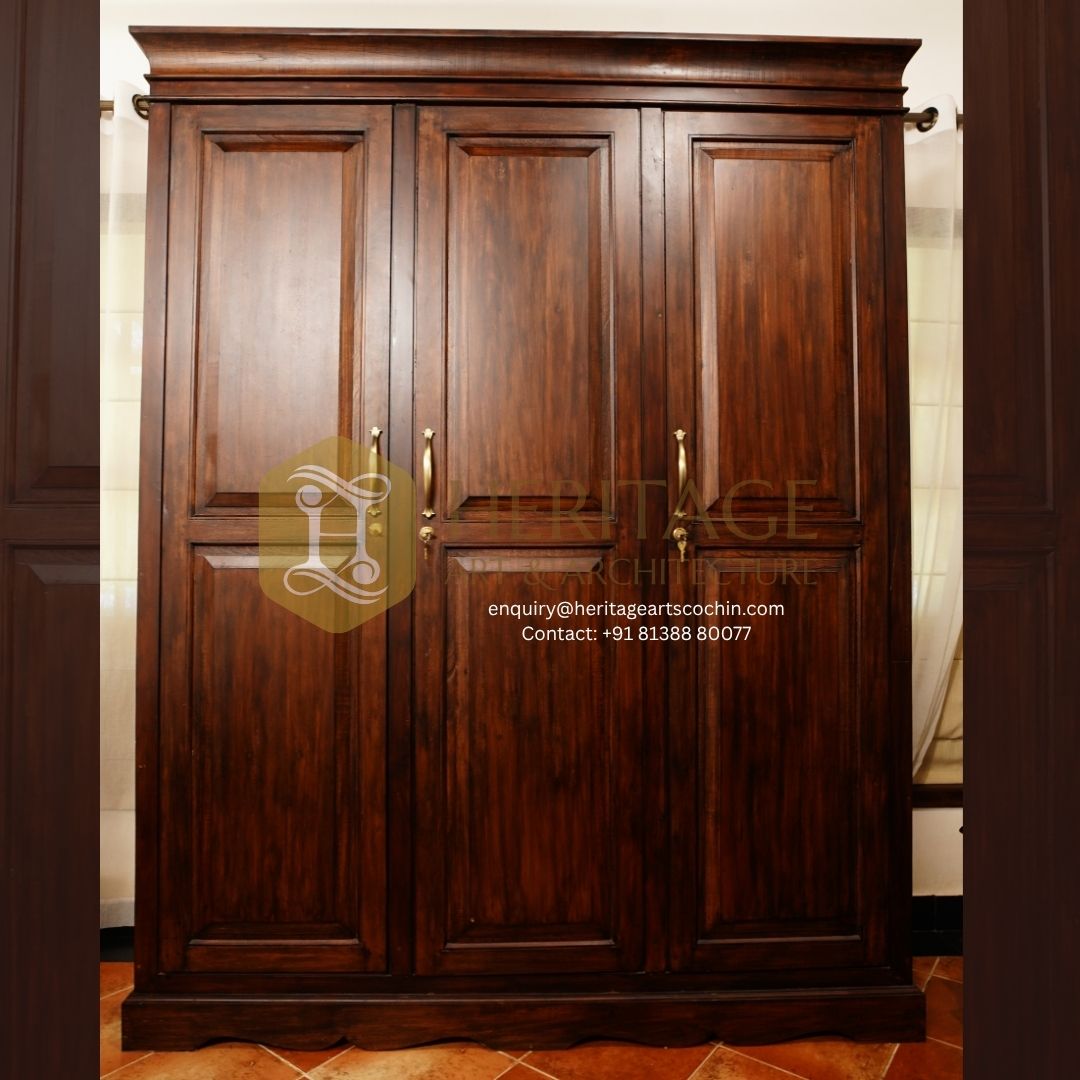
Chettinad furniture operates at a scale that no other Indian domestic tradition matches. The Nattukotai Chettiars — the merchant banking community whose trade networks stretched from Rangoon to Singapore between roughly 1850 and 1930 — built houses with rooms that demanded furniture in proportion: 18-foot ceilings, verandas 15 feet deep, central halls large enough to seat a hundred guests. The furniture that filled these rooms was built to match. A Chettinad teak wardrobe standing eight feet tall, a dining table that seated thirty, a swing bed (oonjal) spanning twelve feet between its ceiling hooks — these are not exaggerations of domestic furniture. They are the correct furniture for rooms of that scale.

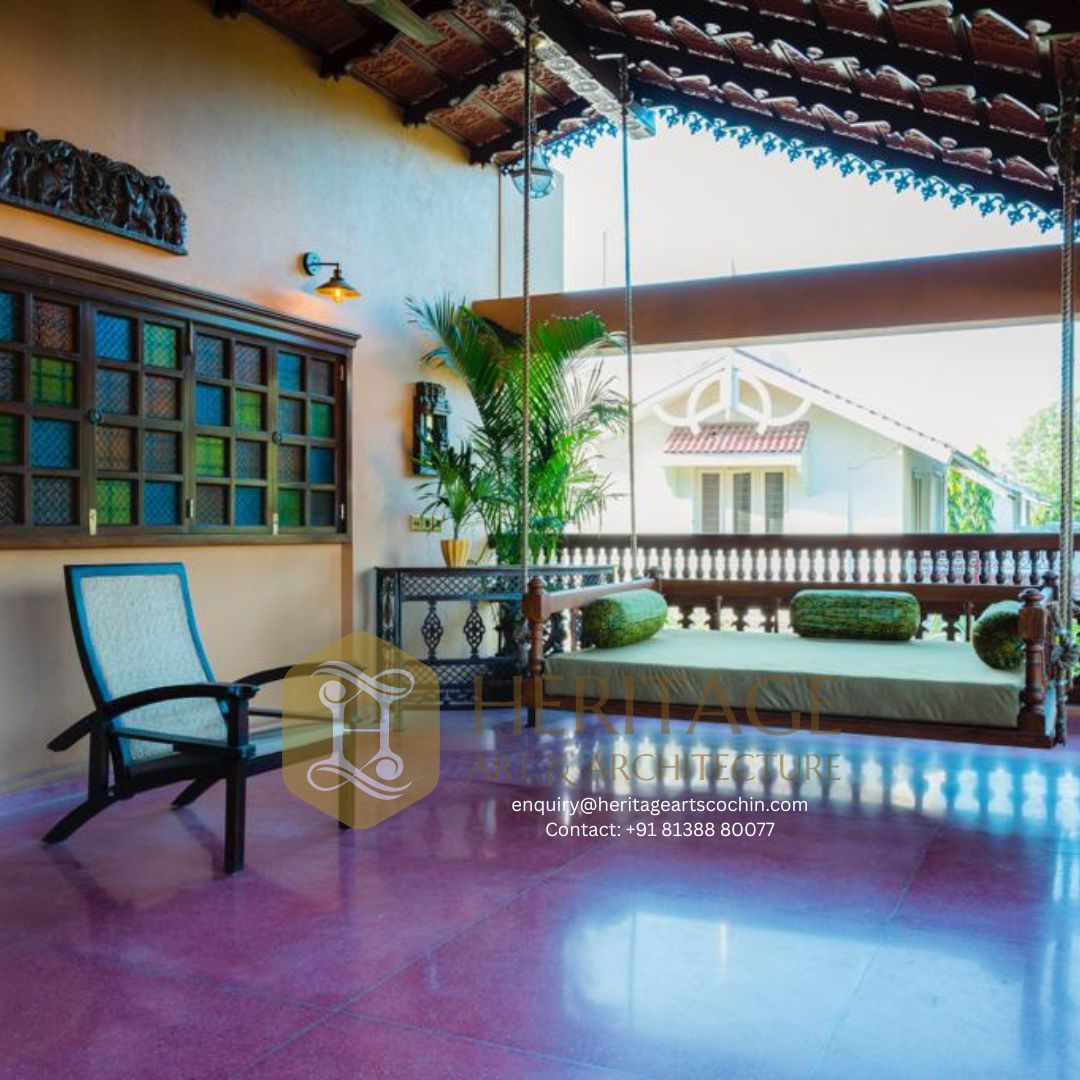
The timber was almost exclusively Burmese teak — brought back through Chettiar trade connections in upper Burma and distinguished from Central Indian teak by its finer grain, higher oil content, and the particular depth of amber it achieves with age. This timber is no longer commercially available. The only Burmese teak now accessible for furniture making in India comes from reclaimed Chettinad houses, which makes each demolition in the Sivaganga and Pudukkottai districts a material loss as well as a cultural one. The carving vocabulary of Chettinad furniture draws from Tamil temple craft — the same peacock, lotus, kirtimukha, and creeper motifs that appear on the gopurams of the region's great temples appear on cabinet door panels and headboard carvings, translated from stone to teak and scaled to domestic proportion. The craftspeople were often trained in both contexts. A Chettinad carpenter who carved a wardrobe door in the morning might work on a temple renovation in the afternoon — the motif system was shared and the technical vocabulary was the same. This is why Chettinad carved furniture reads with architectural authority. The carving was never decorative in the way furniture carving is typically described. It was sacred iconography applied to domestic material. The oonjal deserves specific attention. The swing bed suspended from ceiling beams on iron chains was simultaneously functional — it caught cross-ventilation in the hot interior plains climate, reducing effective temperature through gentle motion in moving air — and ceremonially central. Newly married couples were displayed on the oonjal during wedding functions. Senior household members rested on it through the heat of the afternoon. The piece was the social and spatial axis of the house's interior life. In contemporary homes, an oonjal hung from a purpose-built steel armature or a salvaged teak beam delivers the same functional benefit and carries the same gravitational presence — it reorganises a room around itself simply by occupying it.
Thanjavur & Temple-Town Tamil Nadu — Craft as Devotion
Primary wood: Teak, Indian Rosewood, Neem (Vembu), Pungam
The furniture tradition of the Kaveri delta towns — Thanjavur, Kumbakonam, Srirangam, Madurai — grew in the shadow of the great temples and was shaped by the same aesthetic priorities. The temple mandapam's carved wooden ceiling panels, the processional chariot's figurative carving, the ritual furniture of the sanctum — all of these provided the design vocabulary that domestic furniture makers drew from. The result is a tradition in which furniture carving is understood as a sacred act and the motifs it employs carry specific iconographic weight rather than simply decorative appeal.

The most technically demanding output of this tradition is the brass wire inlay work on rosewood that defines Thanjavur's prestige furniture category. The technique — routing fine channels into the rosewood surface, setting brass wire into those channels to a precise depth, then planishing flush and polishing — requires woodworking and metalworking skills simultaneously. The motifs are temple-derived: lotus compositions, creeper borders, kalasha forms, and geometric star patterns drawn from kolam tradition. The visual result on polished rosewood is a warm gold line drawing against a deep purple-brown ground — a colour relationship that shifts under different light and that no printed or stained substitute approaches. The mixed-species approach of this region is also distinctive. Tamil Brahminic households used Neem (Vembu) for everyday furniture — ritual stools (peetam), low dining platforms (mandai), simple storage — reserving teak and rosewood for pieces intended to endure and be inherited. Neem's pale gold colour against the deeper tones of teak and rosewood in the same room creates a tonal layering that is specifically characteristic of traditional Tamil interiors. Contemporary designers working with this palette find it more nuanced and interior-specific than the single-species approach more common in North Indian furniture practice.
Rajasthan
Primary wood: Sheesham, Mango Wood
Known for painted and carved furniture — jali screens, arch-fronted cabinets, dowry chests with brass hardware. Bold geometric carving. Color often enhanced with lacquer or paint in Shekhawati tradition. In natural sheesham, the design tends toward deep relief carving with strong shadow lines.
Kashmir
Primary wood: Walnut, local softwoods
Fine inlay work using walnut as base with contrasting wood inlays. The Kashmiri khatamband ceiling tradition extends into furniture as a geometric mosaic vocabulary. A different palette from the southern traditions — cooler, darker, with more grey-brown ground color.
The colonial period added another layer to this regional diversity. The British administration's need for functional heavy furniture that could withstand the Indian climate produced a hybrid category — colonial Indo-European furniture — made by Indian craftspeople to European forms but using local timber and local joinery methods. This furniture is now, in many cases, antique, and the reclaimed examples appearing in contemporary interiors carry both the craft quality of Indian woodworking and the formal restraint of colonial furniture design. The combination reads well in modern rooms.
Material Performance

Why These Woods Have Outlasted Everything Made to Replace Them
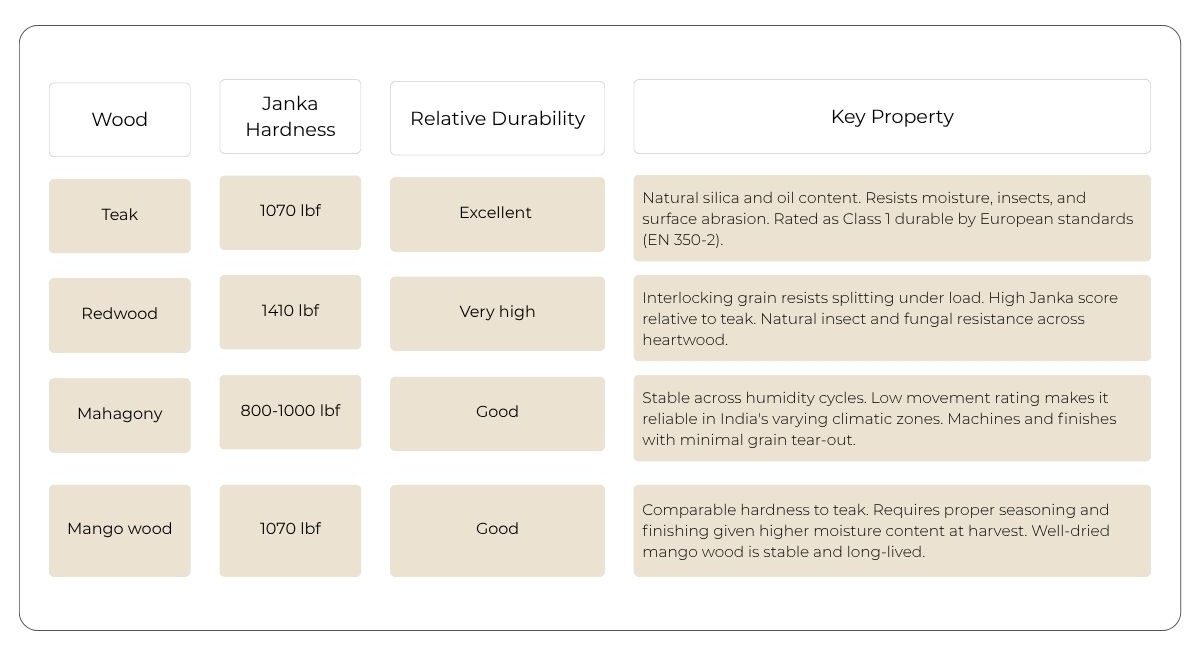
Indian heritage furniture has always been built with the assumption that a piece will survive multiple generations. That assumption is not sentiment — it is structural. The traditional furniture species that dominate Indian craft production have physical properties that make long-term survival a reasonable expectation rather than an optimistic projection.
Janka hardness scores (measured by the Forest Products Laboratory, USDA) quantify the force required to embed a steel ball to half its diameter into a wood surface. They are a reliable proxy for resistance to denting and surface wear. Sheesham's score of approximately 1,410 lbf places it significantly above oak (1,290 lbf) and considerably above pine (870 lbf) — timbers that are routinely specified in European and North American furniture construction as premium materials.
The practical meaning of these numbers is simple: a sheesham dining table will absorb fifty years of daily use without structural compromise, provided its finish is maintained. A teak veranda bench placed outdoors with no treatment except oil will last longer, and age more handsomely, than any treated softwood equivalent. Mahogany, though slightly softer in surface hardness, compensates with its dimensional stability — it does not move substantially with seasonal humidity changes, which is why antique mahogany furniture from the humid South Indian coast has survived in better condition than contemporary furniture made from technically inferior materials.

The most sustainable piece of furniture you can buy is one that lasts long enough for your children to argue about who inherits it.

Reclaimed Timber & Circular Material Practice

Old Wood, New Rooms

Why Reclaimed Matters
The best teak and sheesham available today was grown a hundred years ago and is being rescued from houses being demolished.
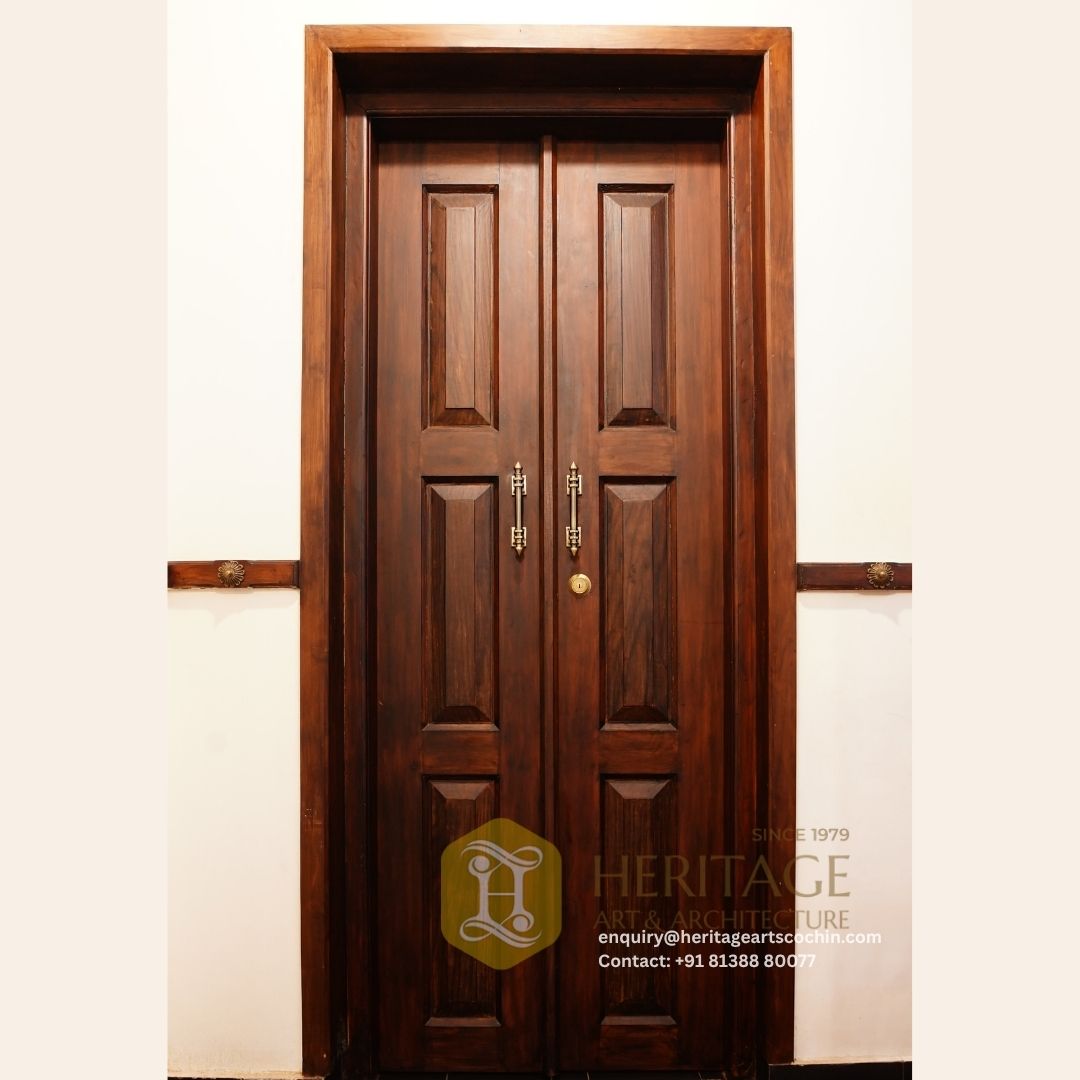
Heritage teak from pre-Independence Indian buildings — havelis, temple structures, rural farmhouses — was harvested from old-growth forest and grown over a century or more. The grain is tighter, the natural oil content is higher, and the wood has already completed decades of dimensional movement and reached a kind of equilibrium that new timber takes years to approximate. Reclaimed old-growth teak is not a second-tier material. It is, in terms of physical quality and material character, superior to any new teak available through commercial channels today.
The demolition of historic Indian vernacular architecture — a process accelerated by urban expansion and real estate pressure since the 1980s — has made reclaimed heritage timber increasingly available through salvage operations. In cities like Jaipur, Jodhpur, and Ahmedabad, architectural salvage dealers maintain stocks of carved doors, window frames, ceiling beams, and structural teak and sheesham elements recovered from demolished havelis. In Kerala, salvage operations recovering timber from traditional nalukettus (four-winged house compounds) have supplied quality teak at dimensions that are simply not available through new timber markets — full-length beams of 14 to 16 inches width, harvested from old-growth trees that no longer exist in commercial forestry.
What Reclaimed Wood Brings to an Interior
The color argument for reclaimed wood is straightforward: a century of oxidation and oil absorption has produced a tone that new wood, however well finished, cannot match. Reclaimed teak is deeper and more complex in color than new teak. The amber has more layers to it. The grain reads more clearly because the softer early-wood cells have compressed slightly with age. When a slab of reclaimed teak is placed next to a piece of new teak with a similar finish, the color difference is immediately legible — and the reclaimed piece is almost invariably richer.
Beyond color, reclaimed wood carries visible history. A beam with mortise cuts from its original structural role, a carved panel with traces of old paint in the recesses, a door plank with the original peg holes — these are not defects. They are evidence that the material existed and was used before this room was built. In interiors that value authenticity and accumulated character, that evidence matters considerably.
The environmental case requires one qualification. Reclaimed wood from heritage structures should be distinguished from reclaimed wood repurposed from industrial sources — railway sleepers, warehouse pallets, shipping crates. The latter category often involves timber treated with preservatives or exposed to contaminants. Heritage structural timber — beams, door frames, carved panels from residential architecture — is the category worth sourcing, and it requires working with dealers who can provide provenance.
Integration & Placement

Traditional Furniture in Contemporary Rooms: The Actual Decisions

The standard anxiety about traditional Indian furniture in modern homes is scale — the assumption that a carved Chettinad almirah or a heavy teak harvest table will overwhelm a contemporary apartment with 9-foot ceilings. This concern is legitimate for some pieces and overstated for most. The more useful question is not scale but register: what conversation is the piece having with the room it is entering, and is that conversation one the room can accommodate?
Living Room Anchor
A carved sheesham coffee table or a low Rajasthani daybed becomes the material focal point in an otherwise restrained room. Pair with plain-weave cotton upholstery and raw plaster walls — surfaces that do not compete with the carving's detail. The carved piece needs visual breathing room, not visual competition.
The Single Statement Piece
A reclaimed teak door converted to a tabletop, or a carved rosewood cabinet placed against a plain white wall, works on the gallery logic: one strong piece, generous space around it. Resist the urge to group multiple carved or heavily figured pieces — they cancel each other out.
Mango Wood for Everyday Use
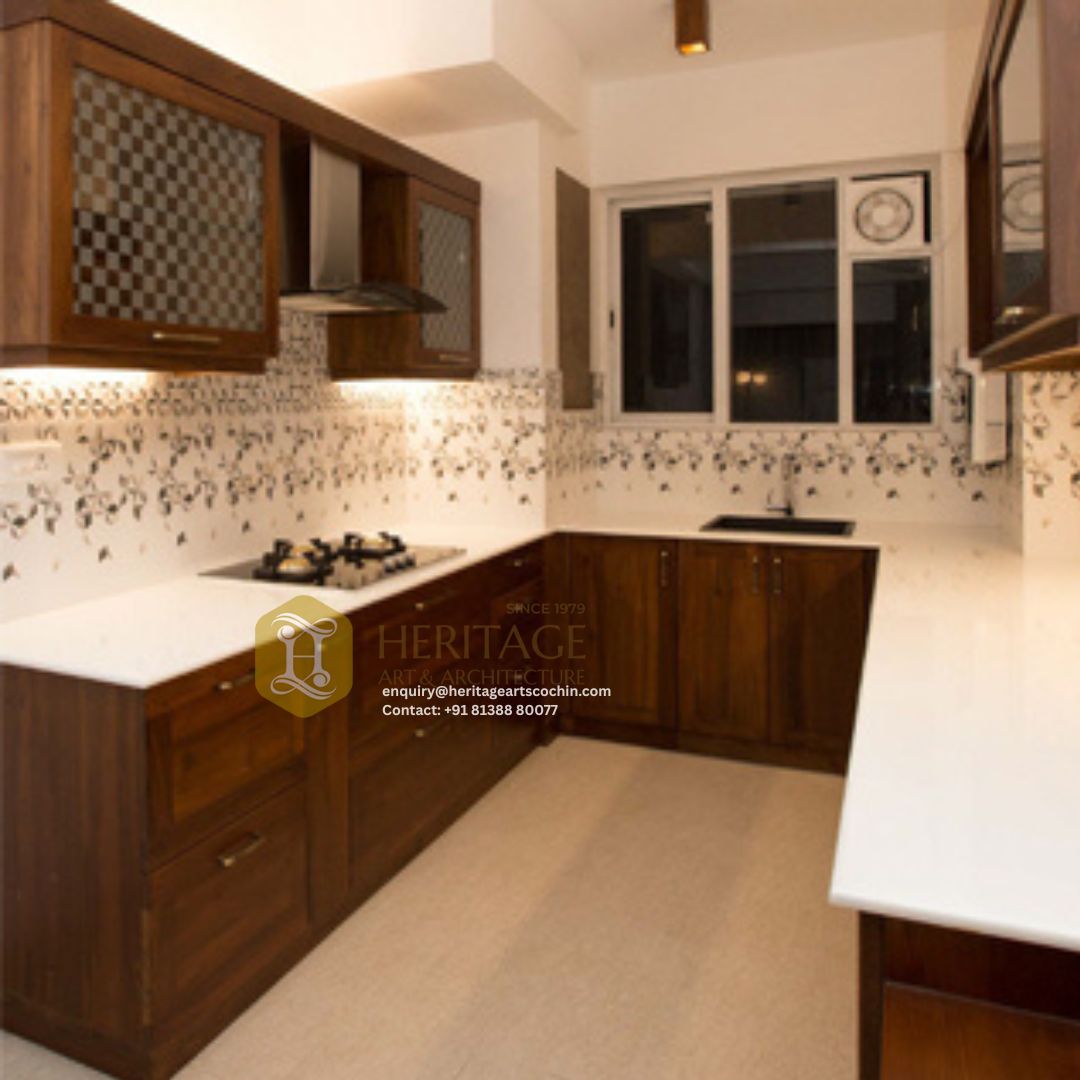
Mango wood's chromatic variation and honest utility make it the most liveable of the four species in daily-use contexts — a kitchen counter, a study desk, a set of side tables. The tonal variation that can feel busy in formal arrangements reads as natural and comfortable in workaday spaces.
Dining Room Authority
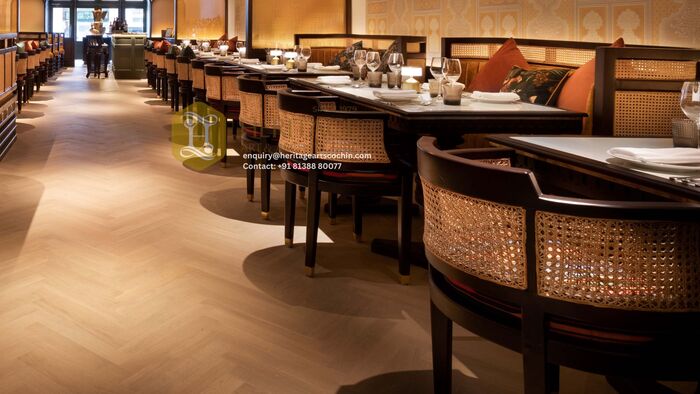
A large teak or mahogany dining table can take over a room — which in a dining context is appropriate. The table should be the room's architectural center. Contemporary chairs in metal, woven cane, or plain upholstery stop the arrangement from reading as a period room and keep the wood's richness legible.
The Colors That Make Heritage Wood Work in Modern Interiors
Wall color is the most consequential decision in placing heritage wood furniture. The tonal relationship between wall finish and wood color determines whether a piece reads as grounded or as though it is fighting for dominance. Heritage wood palettes — amber, red-brown, deep rose-red, honey gold — are warm. They need either a neutral foil or a carefully chosen cool tone to read at their best.
Raw plaster finishes in off-white or warm grey work consistently well across all four species. The plaster's texture is sympathetic to wood grain in a way that paint is not — both surfaces are natural, slightly imperfect, and age similarly. Limewash finishes in pale sage or dusty blue create a specific interplay with sheesham and rosewood, where the cool wall makes the wood's warm red tones come forward without competition. Dark walls — deep navy, charcoal, forest green — work with the right pieces: a teak console against a deep navy wall reads with a richness that light walls cannot achieve, but requires confidence in execution.
What does not work is attempting to neutralise the wood's color by surrounding it with beige and sand. Those tones flatten the warm palette rather than supporting it, and the result is a room that feels neither contemporary nor traditionally rooted — caught between two identities without committing to either.

A carved sheesham cabinet does not need a period room to sit in. It needs a room that is secure enough in its own identity to give one magnificent carved object the space to be itself.

Indian heritage furniture was not made for rooms. It was made to outlast them.
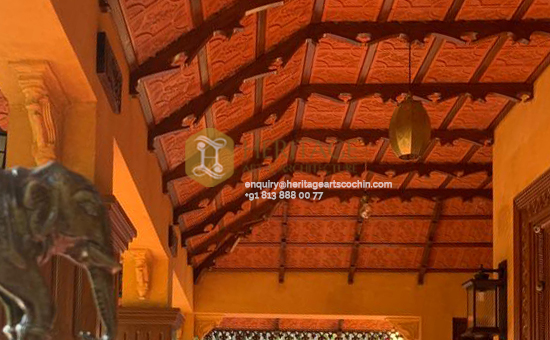
The wood traditions of India — teak from Kerala and Central India, sheesham and rosewood from the north and south, mahogany from the Himalayan foothills, mango wood from the orchards of Rajasthan and Gujarat — each developed within specific regional craft systems that understood the material's properties with a depth that no manual could teach. That knowledge is carried forward in the furniture that came out of those systems, and the furniture carries it into whatever room it enters next.
Contemporary homes in India have, for a generation, largely defaulted to imported styles and mass-produced furniture that has no particular relationship with the country's material culture. The correction is gradual, but it is visible. Architects and interior designers are specifying reclaimed teak alongside poured concrete. Young households are inheriting their grandparents' sheesham pieces and, instead of replacing them, centering rooms around them. Crafted carved doors from demolished havelis are being installed as headboards, room dividers, and artwork.
These decisions are not nostalgia for a specific period aesthetic. They are recognitions that the four woods at the center of India's furniture heritage have color, structural quality, and carving potential that contemporary materials have not matched and are unlikely to surpass. The homes being built to last — the ones accumulating material quality rather than replacing it — know this already. The wood is patient. It will wait to be understood.

Shopping Cart0

Cart

Shopping Cart0

Cart