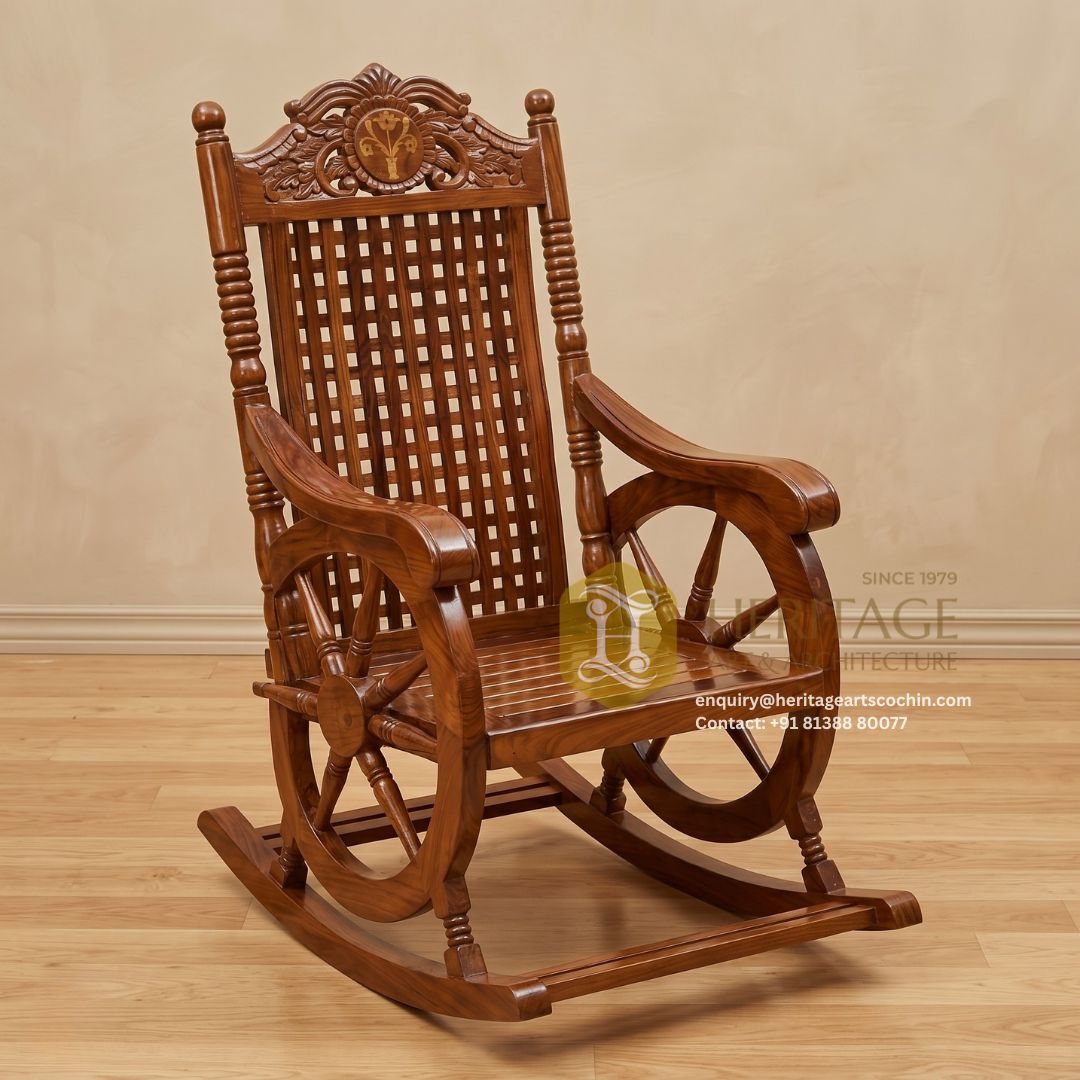
The name brings together two ideas from Indian classical thought: Moksha, meaning liberation or release, and Chakra, the wheel — an ancient form that appears across Indian art and architecture as a mark of continuity, cosmic order, and forward motion. On a rocking chair, the wheel is also simply honest. The chair moves. The wheel is what lets it.
The Jali Backrest
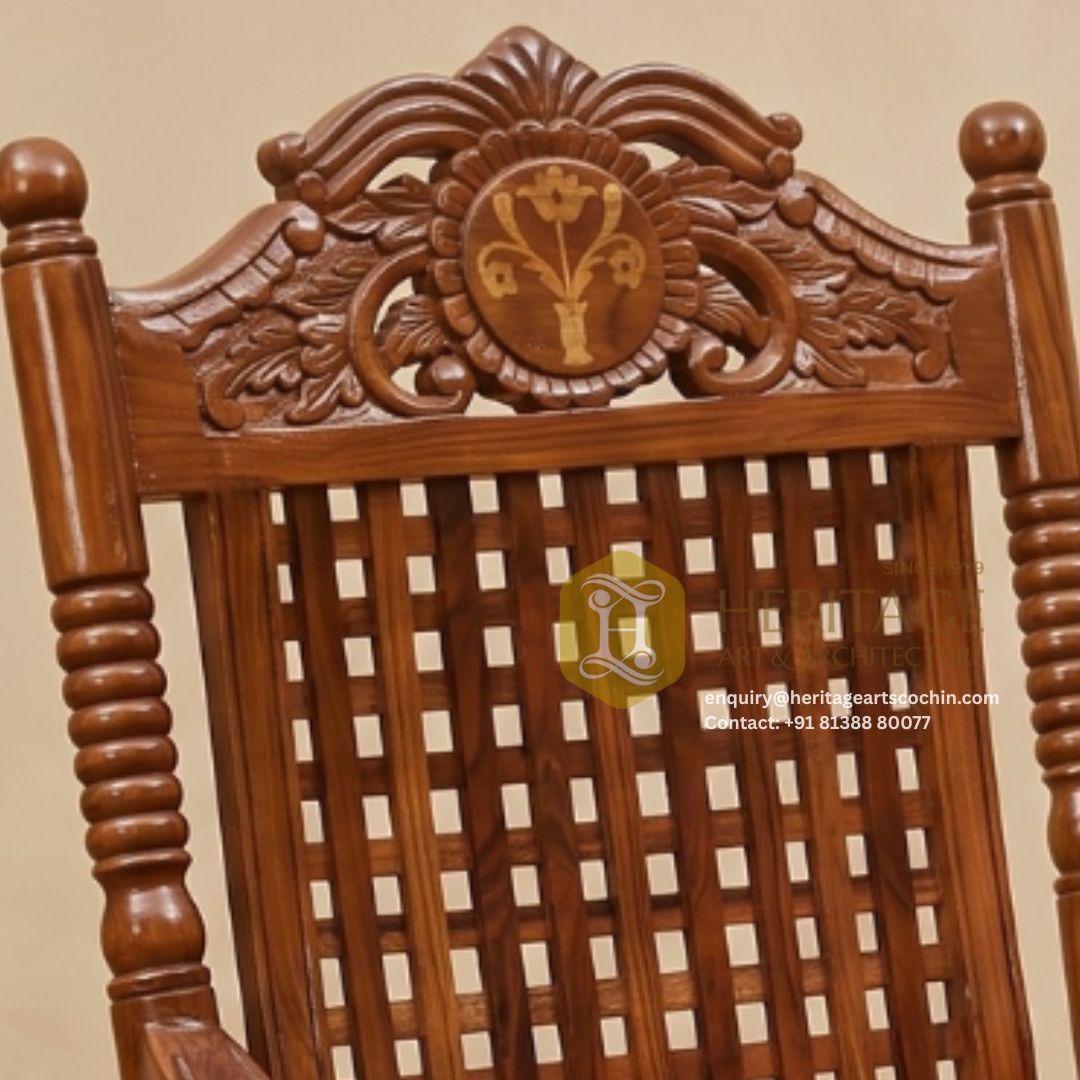
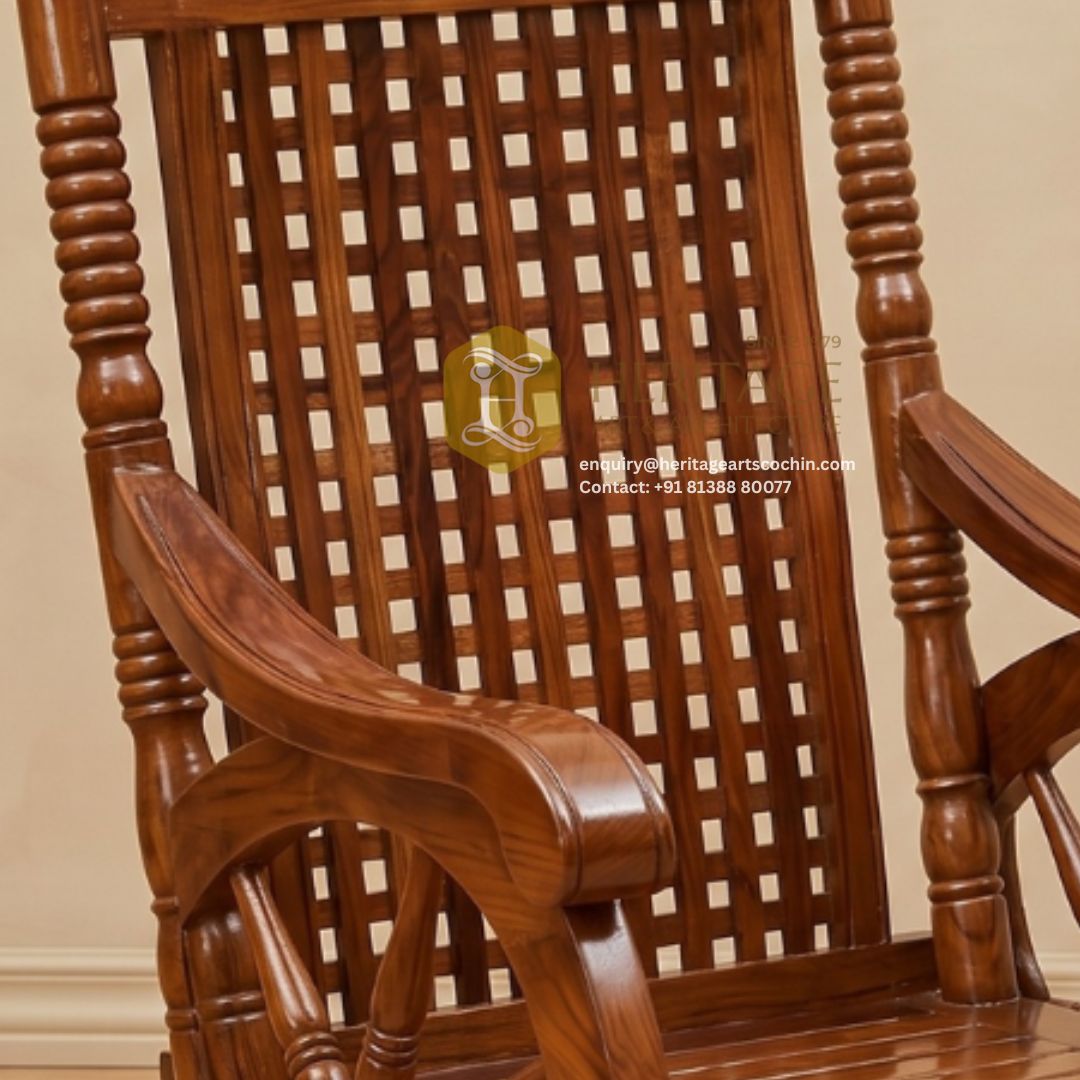
The back of the Moksha Chakra is a full jali — a woven lattice of flat teak strips interlaced in a uniform grid pattern and set within the high rectangular back frame. The grid is open, which allows air to pass through and light to fall across it in a way a solid back never would.
Jali work in Indian architecture appears most extensively in Mughal stone screens and the carved wooden windows of Rajasthani havelis — both built for the same reason: maximum airflow with visual continuity. On the Moksha Chakra, the jali brings that same functional logic to a seating piece. It also keeps the chair visually lighter than its scale would suggest, because the back does not read as a solid mass.
The weave is tight and even across the full back panel. The individual strips are planed and finished to the same standard as the outer frame members.
The Carved Cresting Rail
At the top of the back, a wide cresting rail carries the chair’s primary decorative carving: a central floral medallion with a botanical inlay detail, flanked by scrolling acanthus-style foliage and framed by a shaped and moulded profile. Two turned finials rise at the outer corners of the crest, capping the back posts.
The carving on the cresting rail is the only zone of the chair where ornament takes precedence over structure. The rest of the piece is built to be read as construction — joinery, form, material. The cresting gives the chair its identity from across the room: seen from the front, it is the first thing that registers, and it marks the piece clearly as belonging to the Indian classical furniture tradition.
The Chakra Wheel
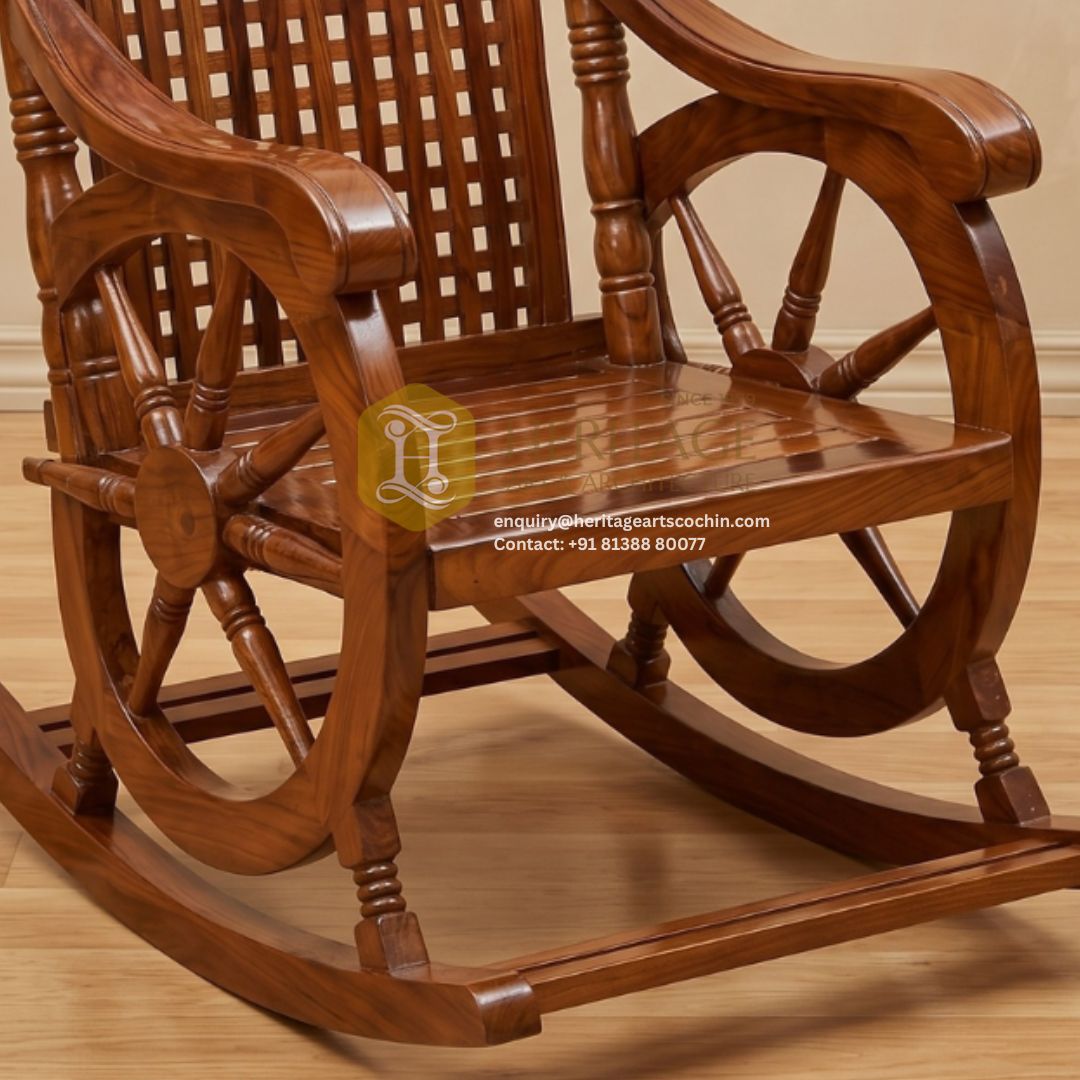
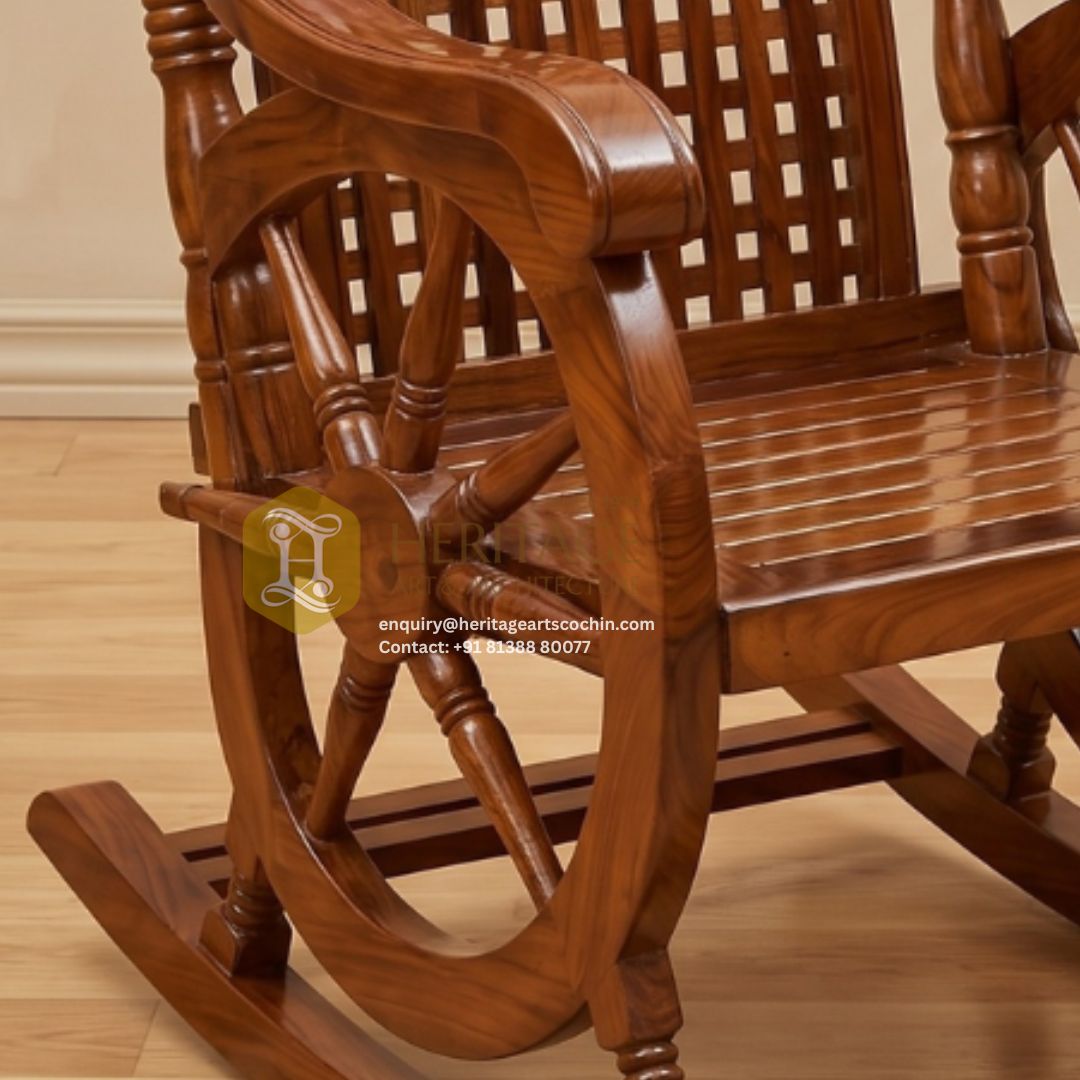
Each side of the chair carries a full spoked wheel in solid teak, positioned at the armrest level and functioning as the lateral structural support between the armrest and the rocker base. The wheel has a turned hub at its centre and six turned spokes radiating outward to a solid rim — the same proportional geometry as a cart or chariot wheel, built at the scale of a chair.
The Chakra is one of the oldest continuous motifs in Indian art. At Konark and Hampi it appears carved in stone at monumental scale; in the Ashoka Chakra it appears on the national flag. On the Moksha Chakra chair it appears as furniture — which is perhaps the most honest form it can take in a domestic space.
The Seat and Rocker Base
The seat is teak, built from fitted planks with visible grain running front to back. The surface is smooth and lacquered. There is no cushion in the base design, though a fitted pad can be added.
The rocker base consists of two long curved runners in solid teak connected by turned cross-stretchers. The curve of the runners is calibrated to give a controlled, even rock — neither too short a motion nor an unstable range of movement. The base sits flush on the floor at rest.
Specifications
| Detail | Specification |
| Primary Material | Solid Teak (Tectona grandis) |
| Back Construction | Woven jali lattice in teak strip |
| Cresting Rail | Hand-carved floral motif with botanical inlay |
| Side Structure | Full spoked chakra wheel, turned hub and spokes |
| Seat | Solid teak plank construction |
| Base | Curved rocker runners with turned stretchers |
| Finish | Hand-rubbed lacquer, warm teak tone |
| Joinery | Mortise and tenon throughout |
| Width | 68 – 72 cm |
| Height | 115 – 120 cm (to top of finials) |
| Depth | 95 – 105 cm (rocker base) |
| Seat Height | Approx. 42 – 44 cm |