Gajathira Canopy Ceiling

/
/
Gajathira Canopy Ceiling

Gajathira Canopy Ceiling

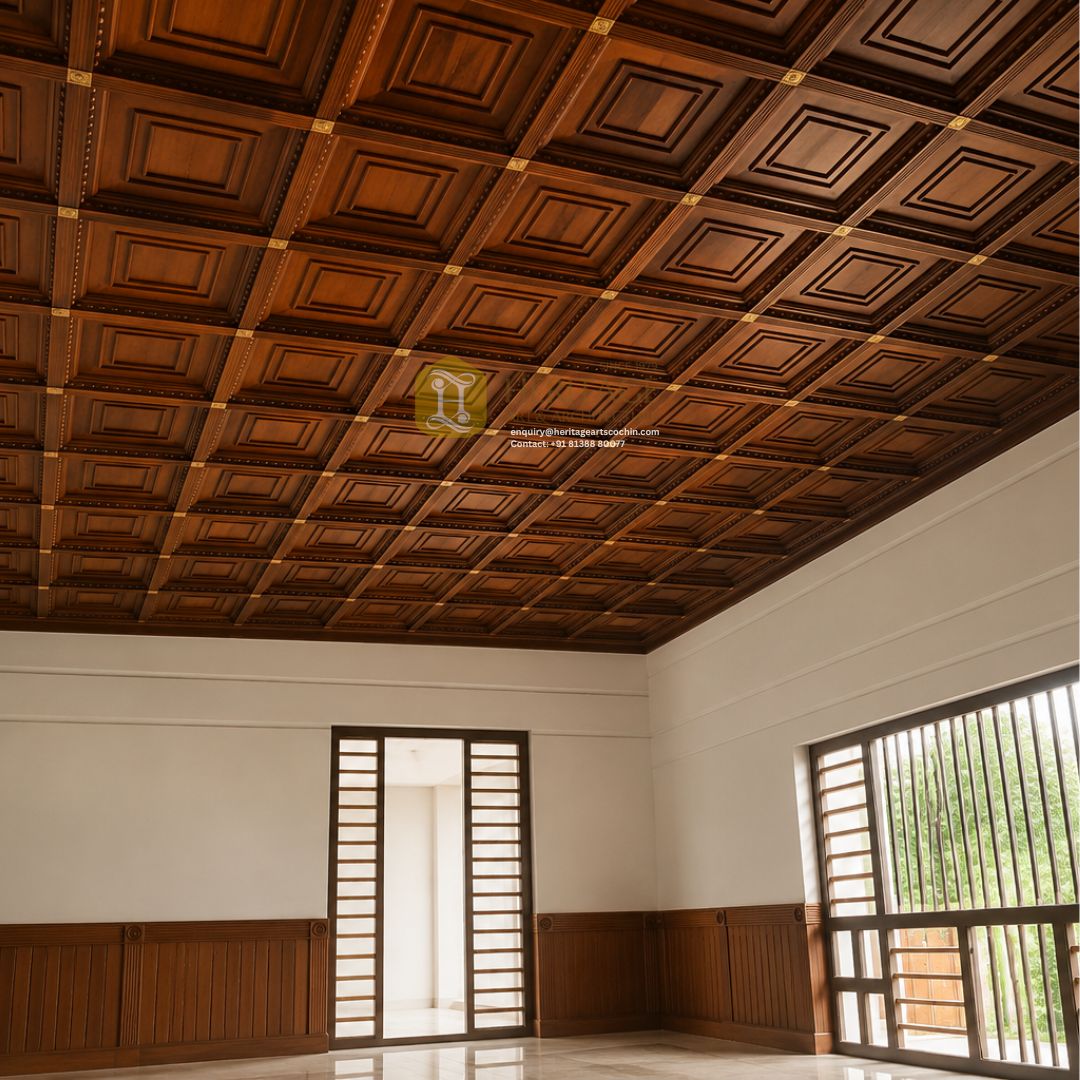
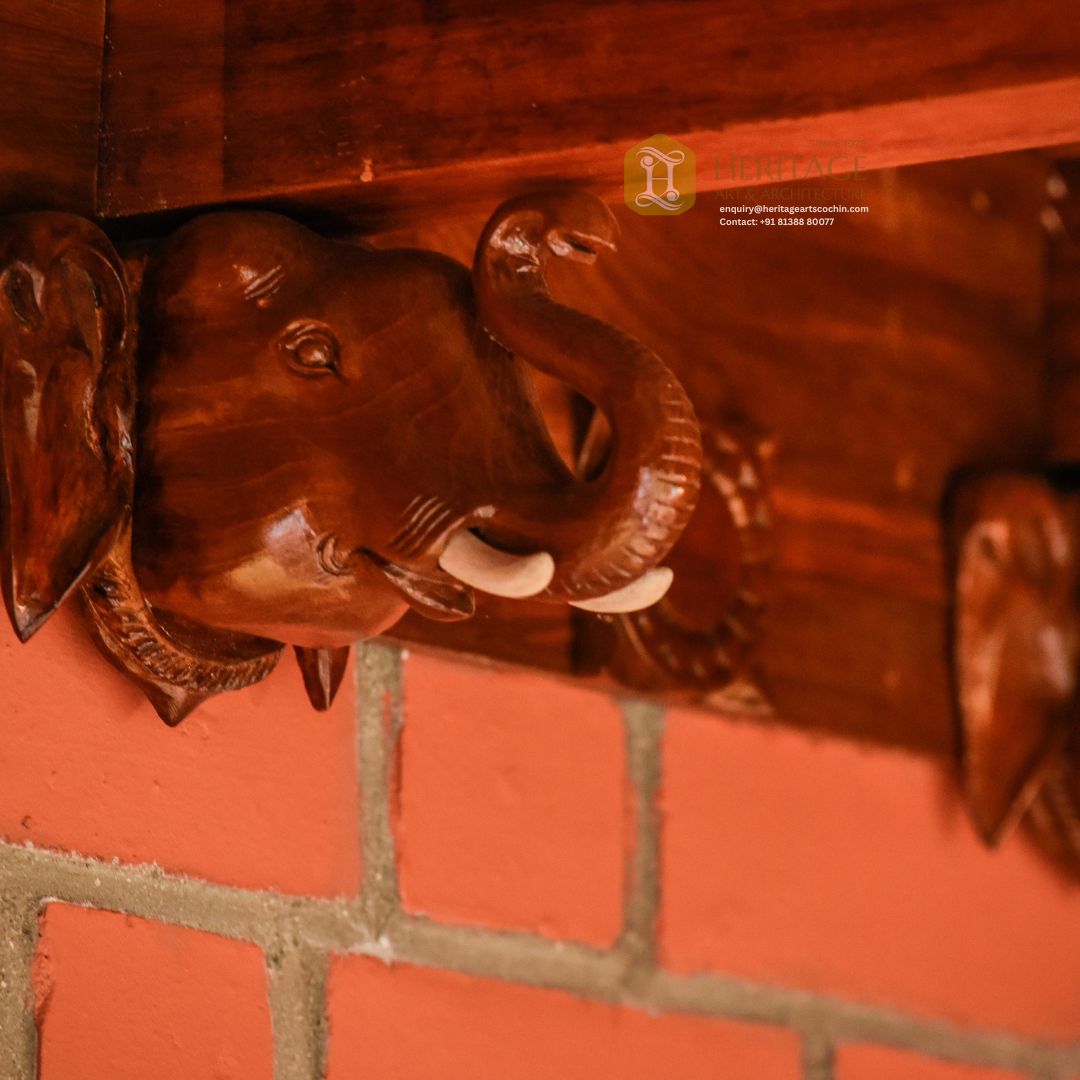
The Gajathira canopy ceiling is a full-span teak timber ceiling commissioned as the defining interior element of a private Kerala residence. Structural beams, infill panels, and carved bracket supports are executed in teak. The ceiling reads as architecture first, ornamentation second. Hand-carved elephant head corbels anchor the eave line, positioned at the junction where the beam grid meets the exterior wall. The result is a ceiling that carries both structural load and cultural weight without announcing either.

Category

Description

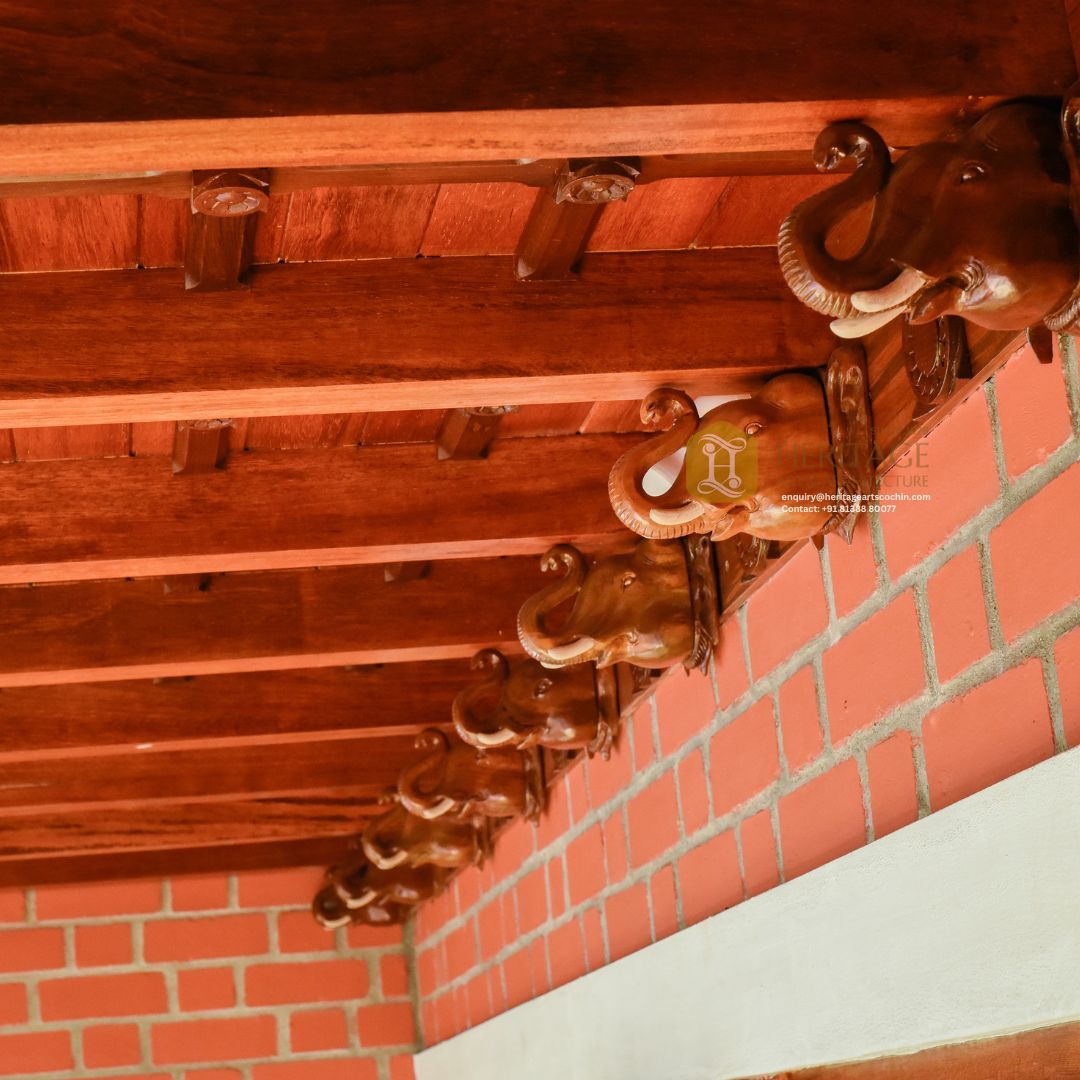
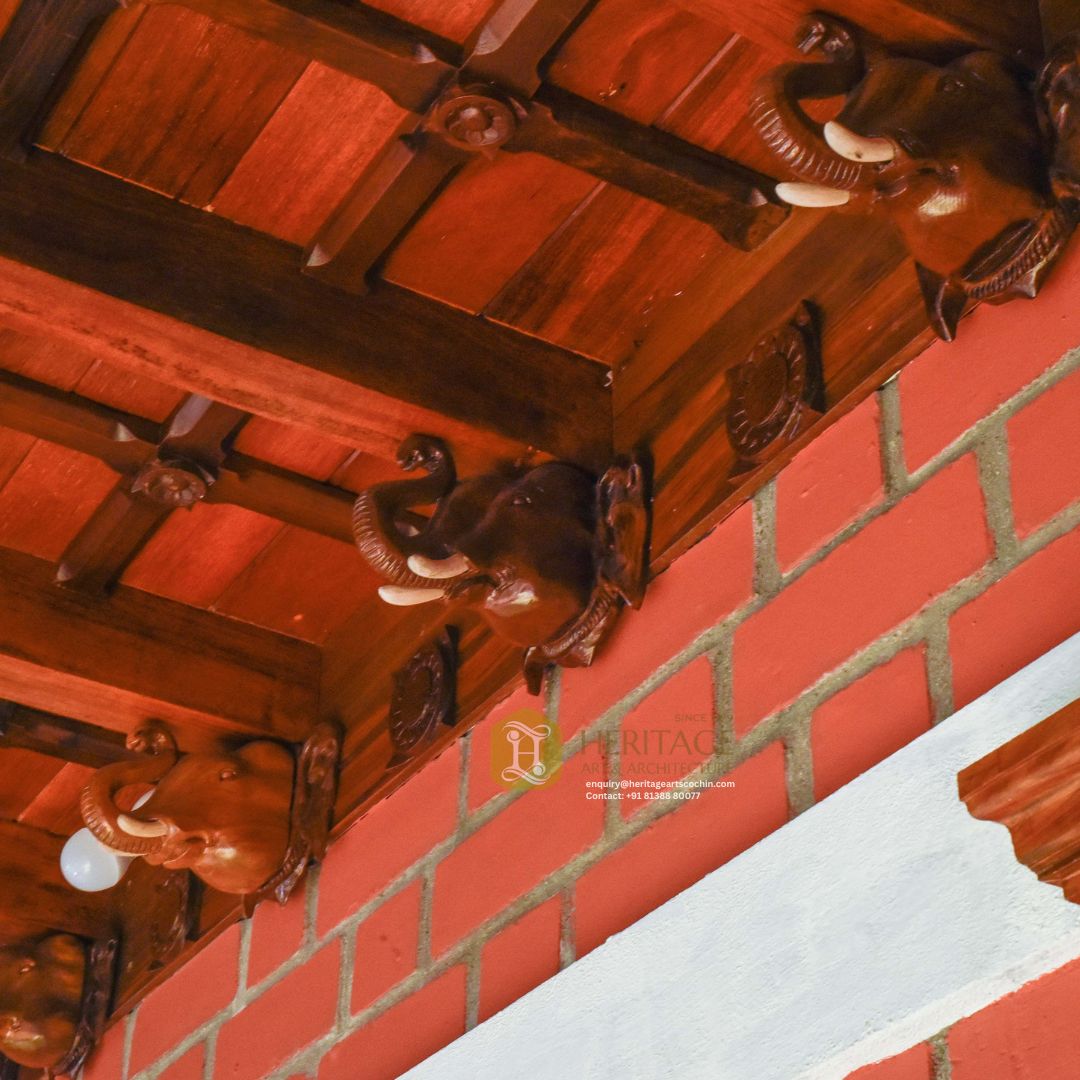
Gaja, the elephant, holds a specific place in Kerala’s built and ritual tradition. In temple architecture, elephant motifs appear at thresholds, on entrance gopurams, and as processional escorts carved into beam ends and corbels. The Gajathira ceiling draws directly from this vocabulary as a structurally integrated motif. The elephant heads here function as bracket corbels, a role they have served in Kerala timber construction for centuries. The coffered teak grid above carries the same proportional logic found in traditional nalukettu ceiling bays: a rhythm of primary beams, secondary crossmembers, and recessed panels that controls both depth and light.

Hand-Carved Elephant Corbels

The trunk curves upward in the auspicious raised position, the tusks are rendered in contrast-finished ivory-toned wood, and the detailing on the trunk ridges, ear edges, and collar band is executed by hand rather than machine-routed. The surface retains tool marks in the recessed areas — evidence of chisel work rather than sanding to uniformity. A second corbel is visible at the lower register, suggesting a paired placement flanking the beam span. The corbels sit proud of the beam face, projecting into the interior volume as functional brackets rather than flat wall reliefs.

Symmetry and Balance

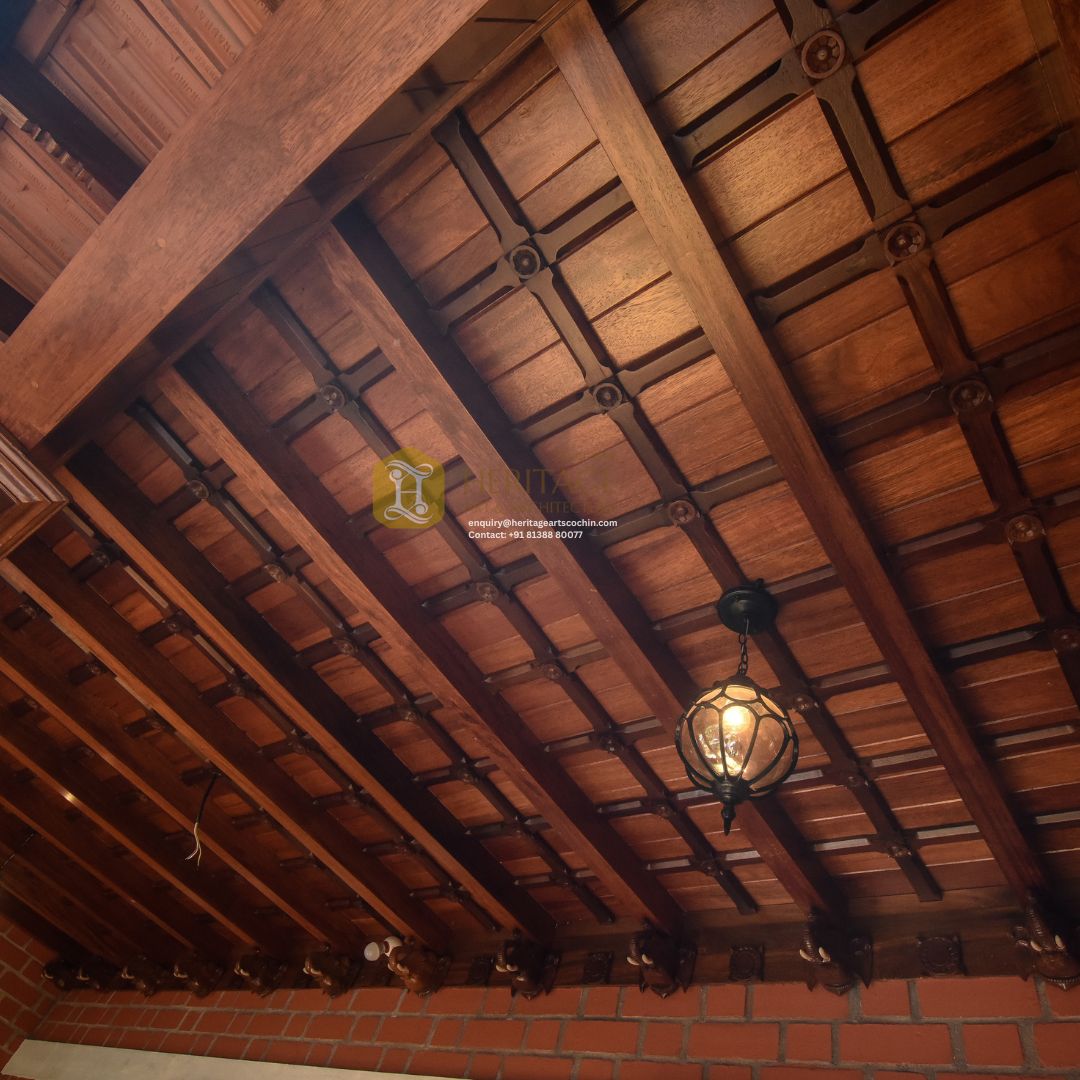
The coffered grid follows a strict module. Primary beams run the long axis of the ceiling; secondary beams intersect at regular intervals to form recessed square panels. At each intersection, a turned wooden boss is set flush with the beam crossing — a detail common to Kerala palace ceilings. The grid creates a perceived depth of approximately 80–100 mm between beam face and panel soffit, which distributes ambient light across the surface rather than concentrating it. Two pendant lanterns in blackened iron are hung along the central axis, consistent with the scale of the bay spacing.

Premium Wood: Teak

The timber used throughout is aged teak. Old-growth teak aged over decades develops a surface colour in the red-brown to dark amber range, which is visible across the beam faces and panel surfaces in the photograph. Teak is specified for ceiling work of this type because of its dimensional stability in humid coastal climates, its natural resistance to fungal and insect attack without chemical treatment, and the quality of its grain under hand-finishing.

Scale, Materials and Dimensions

Estimated from the photograph and standard Kerala residential ceiling conventions.

Element Specification
Ceiling span 5.5 m – 7 m (primary axis)
Primary beam section 150 mm × 200 mm
Secondary beam section 100 mm × 150 mm
Panel infill depth 80 – 100 mm (recessed)
Corbel projection 200 – 250 mm from beam face
Corbel height 350 – 400 mm (base to trunk tip)
Ceiling height 3.2 m – 3.6 m from finished floor level
Pendant fittings Blackened cast iron, chain-hung, ~300 mm globe
Primary material Solid teak throughout — beams, panels, bosses, corbels

More Products

Established in 1979, we carry a legacy that we proudly unfold in front of you. Here tradition blends with creation, art blends with heritage, and finally, a whole new story is carved out in pure wood exclusively for you. 

Shopping Cart0

Cart

Shopping Cart0

Cart

Description

Gaja, the elephant, holds a specific place in Kerala’s built and ritual tradition. In temple architecture, elephant motifs appear at thresholds, on entrance gopurams, and as processional escorts carved into beam ends and corbels. The Gajathira ceiling draws directly from this vocabulary as a structurally integrated motif. The elephant heads here function as bracket corbels, a role they have served in Kerala timber construction for centuries. The coffered teak grid above carries the same proportional logic found in traditional nalukettu ceiling bays: a rhythm of primary beams, secondary crossmembers, and recessed panels that controls both depth and light.

Hand-Carved Elephant Corbels

The trunk curves upward in the auspicious raised position, the tusks are rendered in contrast-finished ivory-toned wood, and the detailing on the trunk ridges, ear edges, and collar band is executed by hand rather than machine-routed. The surface retains tool marks in the recessed areas — evidence of chisel work rather than sanding to uniformity. A second corbel is visible at the lower register, suggesting a paired placement flanking the beam span. The corbels sit proud of the beam face, projecting into the interior volume as functional brackets rather than flat wall reliefs.

Symmetry and Balance

The coffered grid follows a strict module. Primary beams run the long axis of the ceiling; secondary beams intersect at regular intervals to form recessed square panels. At each intersection, a turned wooden boss is set flush with the beam crossing — a detail common to Kerala palace ceilings. The grid creates a perceived depth of approximately 80–100 mm between beam face and panel soffit, which distributes ambient light across the surface rather than concentrating it. Two pendant lanterns in blackened iron are hung along the central axis, consistent with the scale of the bay spacing.

Premium Wood: Teak

The timber used throughout is aged teak. Old-growth teak aged over decades develops a surface colour in the red-brown to dark amber range, which is visible across the beam faces and panel surfaces in the photograph. Teak is specified for ceiling work of this type because of its dimensional stability in humid coastal climates, its natural resistance to fungal and insect attack without chemical treatment, and the quality of its grain under hand-finishing.

Scale, Materials and Dimensions

Estimated from the photograph and standard Kerala residential ceiling conventions.

Element Specification
Ceiling span 5.5 m – 7 m (primary axis)
Primary beam section 150 mm × 200 mm
Secondary beam section 100 mm × 150 mm
Panel infill depth 80 – 100 mm (recessed)
Corbel projection 200 – 250 mm from beam face
Corbel height 350 – 400 mm (base to trunk tip)
Ceiling height 3.2 m – 3.6 m from finished floor level
Pendant fittings Blackened cast iron, chain-hung, ~300 mm globe
Primary material Solid teak throughout — beams, panels, bosses, corbels