
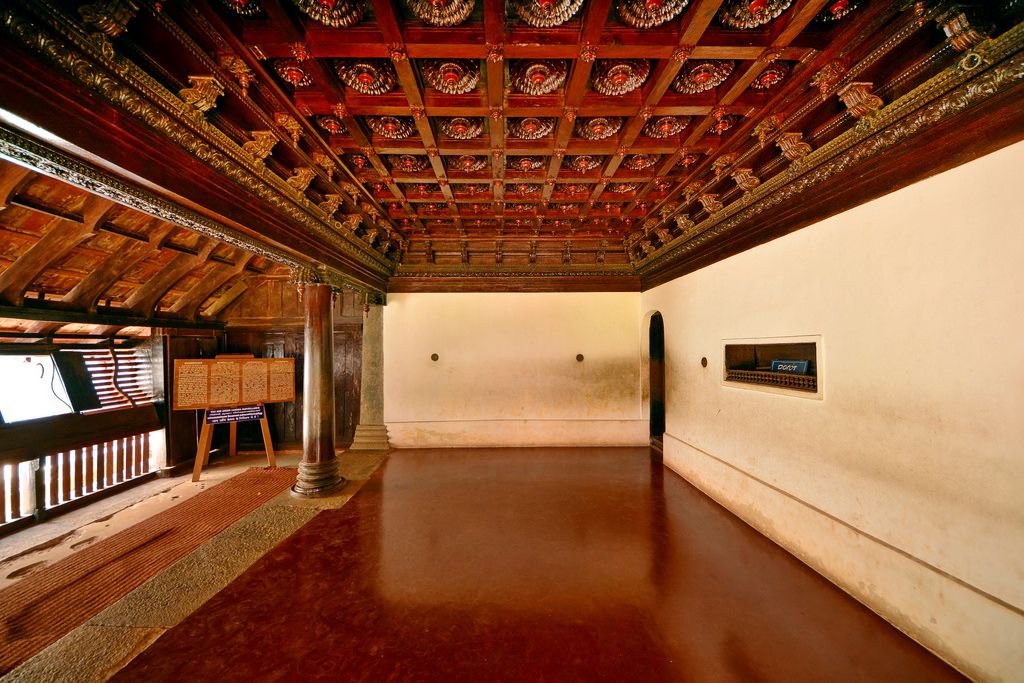
Three regions. Three entirely different relationships with wood, climate, and the idea of what a room should do for the people living in it. And a shared material intelligence that contemporary interiors are only beginning to catch up with.

Most furniture tells you where it was made only if you know what to look for. South Indian furniture announces it. A Chettinad teak swing bed hung from ceiling beams tells you something specific about the wealth of the Nattukotai Chettiars, about their trade routes to Burma and Southeast Asia, and about the scale of the rooms they built to house themselves. A Kerala rosewood writing cabinet tells you about a different set of values altogether — more restrained, more architecturally integrated, more interested in the precision of joinery than in the drama of display. A Thanjavur brass-inlaid wooden panel has its own conversation to carry, one rooted in the cultural patronage networks that surrounded the great temples of the Kaveri delta.
These are not decorative differences. They are differences of climate, material availability, social structure, and the specific requirements that each imposed on the people who made furniture for a living. Understanding those requirements is what makes placing South Indian furniture in a contemporary home something other than a decorative gesture. The pieces were engineered for conditions. Many of those conditions — humidity, heat, the value of airflow, the need for furniture that does not impose on a room — are exactly what contemporary sustainable design is working toward from first principles.
Climate & Material Logic
How the Weather Built the Furniture
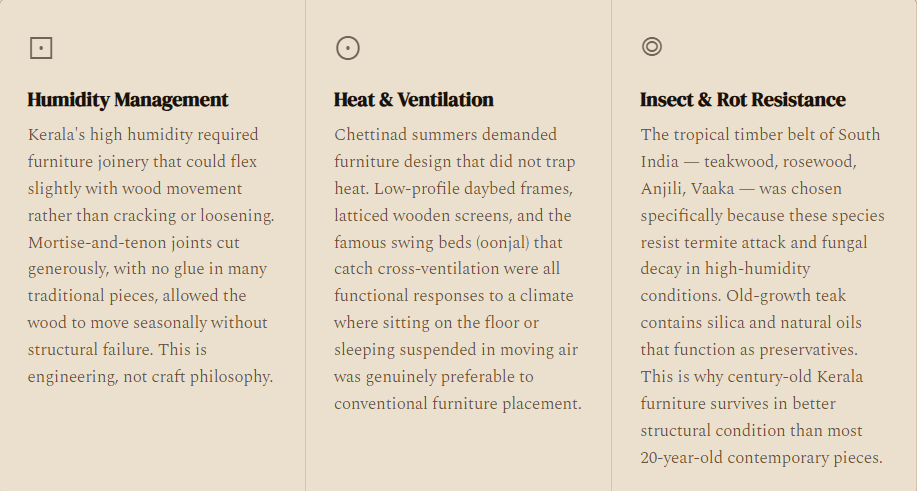
South India’s climate ranges from the intense coastal humidity of Kerala’s Malabar coast — where annual rainfall can exceed 3,000 mm — to the drier, hotter interior plateau conditions of central Tamil Nadu, to the semi-arid microclimate of the Chettinad region, which sits on a flat, largely treeless plain that reaches temperatures above 40°C in summer. Each of these climatic conditions produced a different furniture response.
The climate logic also shaped the interior layouts that South Indian furniture inhabited. The Kerala nalukettu — a four-winged house built around a central courtyard open to the sky — required furniture that worked within a constant flow of air and changing light. Pieces were kept low to the floor, deliberately modest in profile, so that the architecture could breathe around them. The Chettinad house, by contrast, had deep verandas, high ceilings of up to 18 feet, and rooms connected by open corridors — a spatial system that allowed large, ceremonial furniture to occupy specific rooms without oppressing the rest of the house.
Both approaches are instructive for contemporary home design in South India, where the same climate conditions still apply and where the architectural impulse to seal and air-condition everything is increasingly being questioned by designers who recognise what is being lost in thermal and sensory terms.

The furniture of Chettinad is the product of extraordinary accumulated wealth and a very specific set of trade connections. The Nattukotai Chettiars — the merchant banking community that built the great mansions of the Chettinad region — were active across Burma, Ceylon, Malaysia, Singapore, and Indochina from the mid-nineteenth century through the first decades of the twentieth. They brought back timber, building materials, and design influences from every port they operated in, and they poured all of it into houses that remain, even in their partially demolished state, among the most astonishing domestic architecture in India.
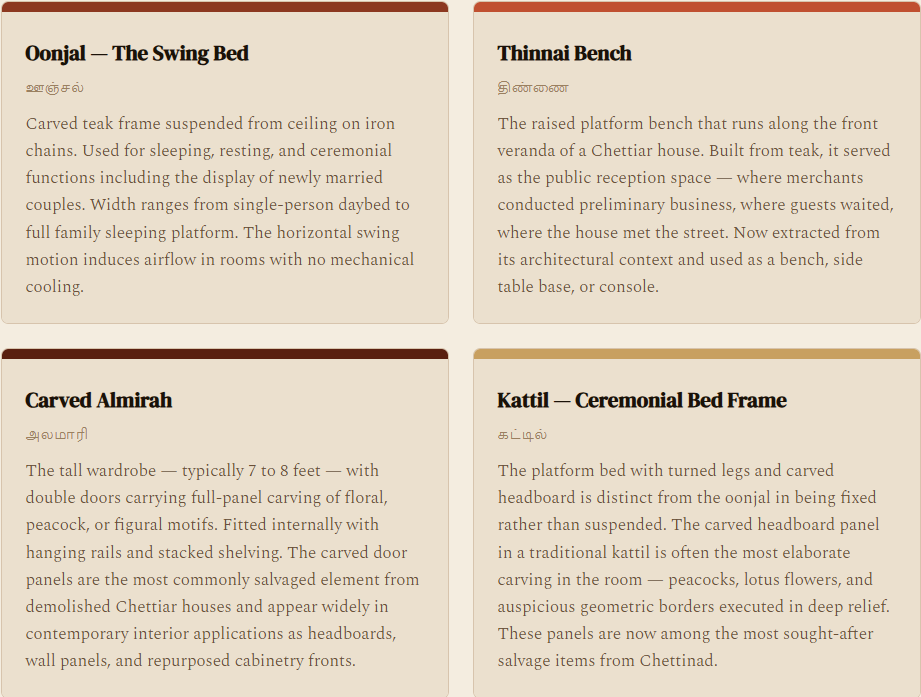
Chettinad furniture is architecturally scaled. The oonjal — the wooden swing bed hung from ceiling hooks on iron chains — is the most immediately recognisable piece, but it is only the beginning. Teak wardrobes standing eight feet tall, carved with floral panels and fitted with beveled glass mirrors imported from Belgium, were standard in any significant Chettiar house. Teak dining tables long enough to seat thirty were not unusual in houses built for ceremonial hospitality. Wooden pillars, sometimes carved and sometimes plain, supported the heavy roof structures of the central reception rooms. The furniture and the architecture were conceived together, and separating one from the other was never the intention.

The Signature Pieces
The Craft Behind the Scale
Chettinad’s carving tradition draws heavily on the temple-craft vocabulary of Tamil Nadu — the same motifs (peacock, lotus, kirtimukha, kalasha) that appear on gopurams appear on domestic furniture, translated from stone to teak and scaled to interior proportions. The craftspeople who built Chettiar house furniture were often working from the same design vocabulary as temple builders, and the quality of execution reflected the patronage available: Chettiar merchants were among the wealthiest private patrons in colonial South India, and the furniture they commissioned reflected that capacity without apology.
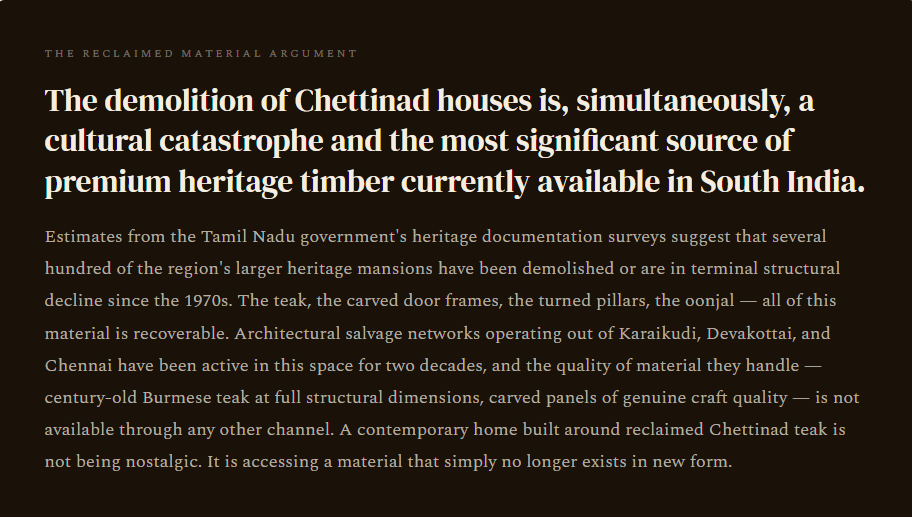
The timber itself tells the trade story. The teak in many Chettinad pieces is Burmese — specifically from the teak forests of upper Burma that Chettiar merchants accessed through their banking networks in Rangoon. Burmese teak is distinguishable from Central Indian teak by its slightly finer grain and higher oil content, which accounts for the particular depth and evenness of colour in older Chettinad pieces. This timber is no longer commercially available, which makes the reclaimed furniture from these houses genuinely irreplaceable as a material source.
The oonjal is not a decorative piece placed in a room. In Chettinad, it was the room — the spatial and social centre of the house’s interior life, around which everything else was arranged.

Kerala furniture thinks differently about the room. Where Chettinad favours scale and ceremonial presence, Kerala’s furniture tradition prizes integration — the sense that a piece belongs to its architectural context as completely as a structural column or a carved bracket does. This is not an accident of taste. It comes directly from the nalukettu building tradition, in which the house is conceived as a single integrated system of structure, ventilation, light management, and domestic ritual. Furniture in this system is not placed in rooms. It completes them.
The primary timbers of traditional Kerala furniture are teak, rosewood (Dalbergia latifolia, which grows in the forests of the Western Ghats), Anjili (Artocarpus hirsutus — also called wild jackwood), and Vaaka (Albizia lebbeck). Each has a distinct colour and grain character, and Kerala craftspeople have historically used all of them in combination, choosing species based on the structural or decorative role of the specific component.

Joinery as Design Language
The distinguishing quality of Kerala woodworking is its joinery. The joints in a traditional Kerala piece — the mortise-and-tenon connections, the dovetailed corners, the wedged through-tenons — are not hidden. They are often expressed on the surface of the piece as part of its visual grammar. A Kerala settle might have the peg ends of its tenon joints sitting flush on the outer surface of its arm rails, or slightly proud of it, so that the structural logic of the piece is readable from the outside. This quality — joinery that is simultaneously functional and aesthetic — is the formal signature of the tradition.
1. Mortise-and-Tenon (No Glue)
Traditional Kerala joiners cut mortise-and-tenon joints to a fit that relies on wood-to-wood friction and seasonal swelling rather than adhesive. In high-humidity environments, this is more durable than glue, which degrades with repeated wet-dry cycling. A well-cut dry joint in teak will outlast a glued joint in the same species by decades.
2. Through-Tenon with Wedge
The wedged through-tenon — where the tenon passes completely through the mortised member and is locked with a wooden wedge — is structurally irreversible without deliberate disassembly. This joint type is found in Kerala furniture intended for permanent placement: the heavy rosewood writing tables, the carved teak settles that served as formal reception seating in wealthier households.
3. Keel Joint (Theepetti)
Found in Kerala chest and box construction, the keel joint — a triangular tongue-and-groove fitted along the length of two boards — provides exceptional resistance to racking forces without the need for corner reinforcement. It is a technique specific to this tradition and not commonly found outside the Kerala craft sphere.
4. Wooden Peg Fastening
Where metal fasteners would corrode in high-humidity conditions, Kerala woodworkers used wooden pegs — typically in a harder species than the surrounding timber — to lock joints. The differential hardness allows the peg to be driven without splitting, and its wood-to-wood contact is unaffected by the salt air of the coastal environment.
The Signature Pieces
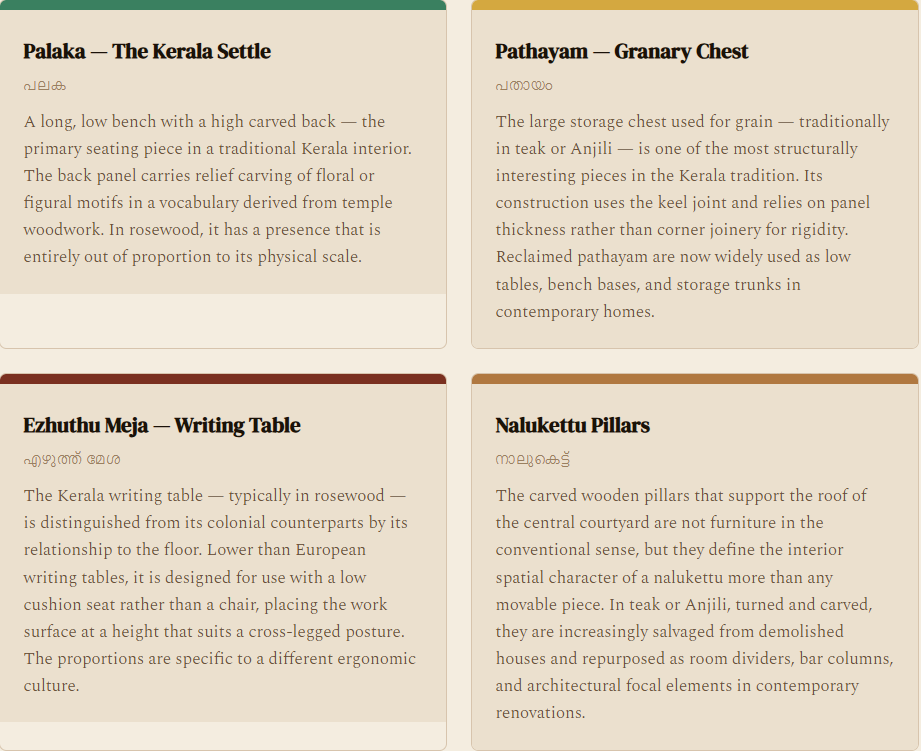
Kerala woodwork never announces itself. The craft is in the joints, in the grain alignment across a panel, in the way two pieces of Anjili from the same tree have been placed so their colour reads as continuous. It rewards looking, not glancing.

Tamil Nadu’s mainstream furniture tradition — distinct from Chettinad’s mercantile excess — is rooted in temple culture and the Brahminic household. The great temple towns of the Kaveri delta (Thanjavur, Kumbakonam, Srirangam) generated both the craft patronage and the design vocabulary that shaped domestic furniture across the region. Motifs that appear on the wooden mandapams of Brihadeeswara temple at Thanjavur appear, at reduced scale, on the furniture made for the households of the priestly and administrative families that lived in the shadow of those temples.
The material palette here is somewhat different from Kerala. The Kaveri delta is further from the Western Ghats timber belt, and historically drew on locally available species — Vembu (Neem), Nelli (Indian Gooseberry), and Pungam (Pongamia) — for everyday furniture, reserving the premium teak and rosewood for significant pieces. This mixed-species approach is visible in traditional Tamil Nadu interiors, where the colour range of furniture within a single room can shift from the pale gold of neem through the warm brown of teak to the deep red-brown of rosewood, all within a coherent visual system.

Temple Craft and Domestic Form
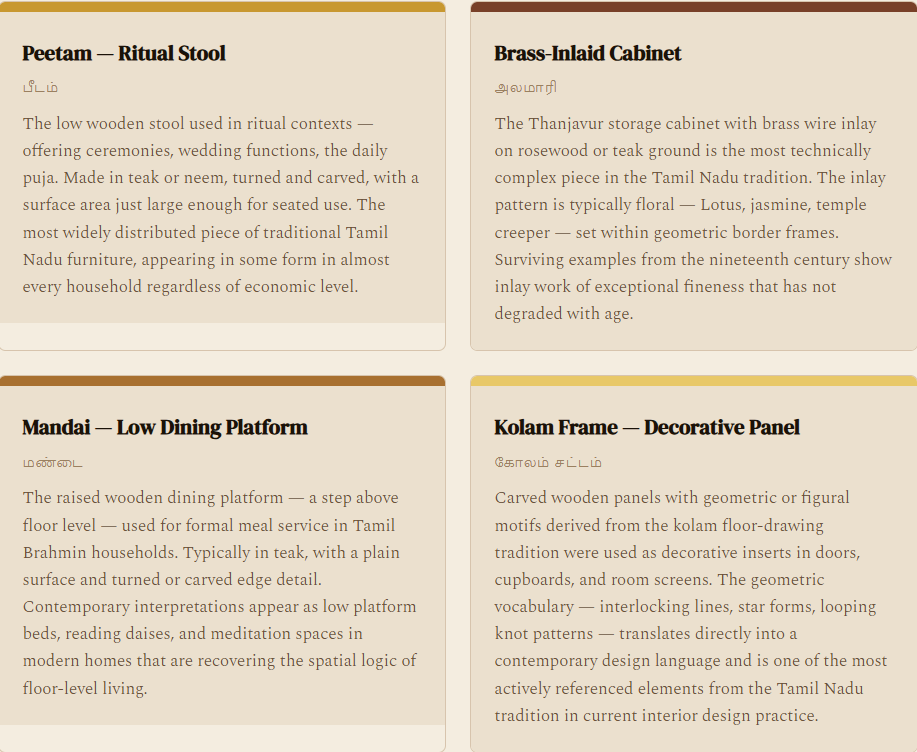
The Thanjavur tradition of brass and ivory inlay on wood deserves particular attention. The technique — karu veppu in Tamil — involves setting thin brass wire or brass sheet into routed grooves in the wood surface, then planishing flush and polishing. The visual result is a warm gold line drawing against the deep-toned wood ground. On a traditional Thanjavur piece, this inlay might outline a full lotus composition across a cabinet door or trace a border of creeper motifs around a table edge. The craft requires both woodworking and metalworking skill, which is why it was historically concentrated among families who maintained both traditions.
Brass inlay on rosewood has a particular visual quality that no painted or veneered reproduction achieves: the metal takes the ambient light and holds it in a way that shifts as the viewing angle changes. A brass-inlaid rosewood piece in raking afternoon light looks different from the same piece under overhead illumination. This is not a subtle effect — it is one of the primary reasons the technique survived as long as it did under commercial pressure from cheaper alternatives.
The Signature Pieces
Contemporary Relevance
Finding a Place in the Modern Home
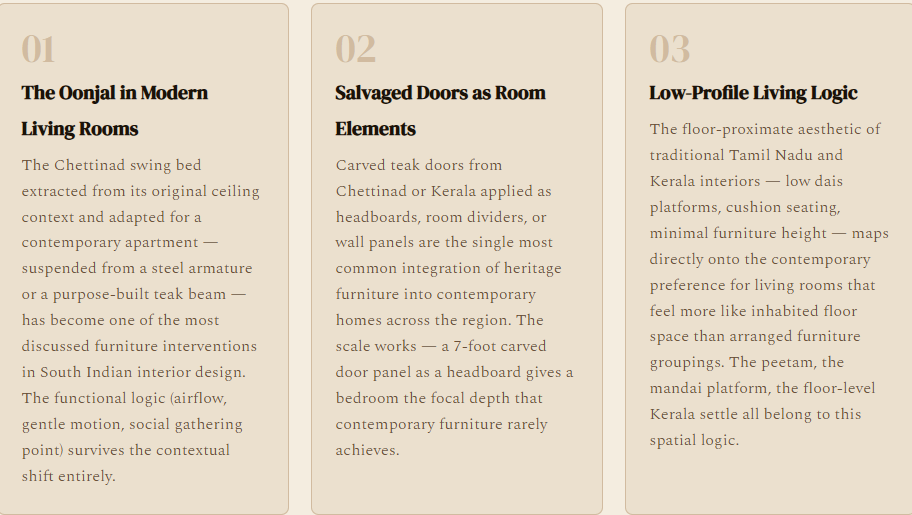
The conversation about South Indian heritage furniture in contemporary interiors has moved past the point of being a niche design interest. Architects working in Chennai, Kochi, Bengaluru, and Thiruvananthapuram are specifying reclaimed Chettinad teak, commissioning reproductions of Kerala settle forms, and working with salvaged carved panels as primary design elements rather than as decorative supplements to otherwise conventional rooms. The growing demand for teak wood furniture in Kerala reflects a broader shift visible in completed projects and in residential briefs from clients who have absorbed enough of this design language to know specifically what they want.
Colour and Context: Placing South Indian Wood in Contemporary Rooms
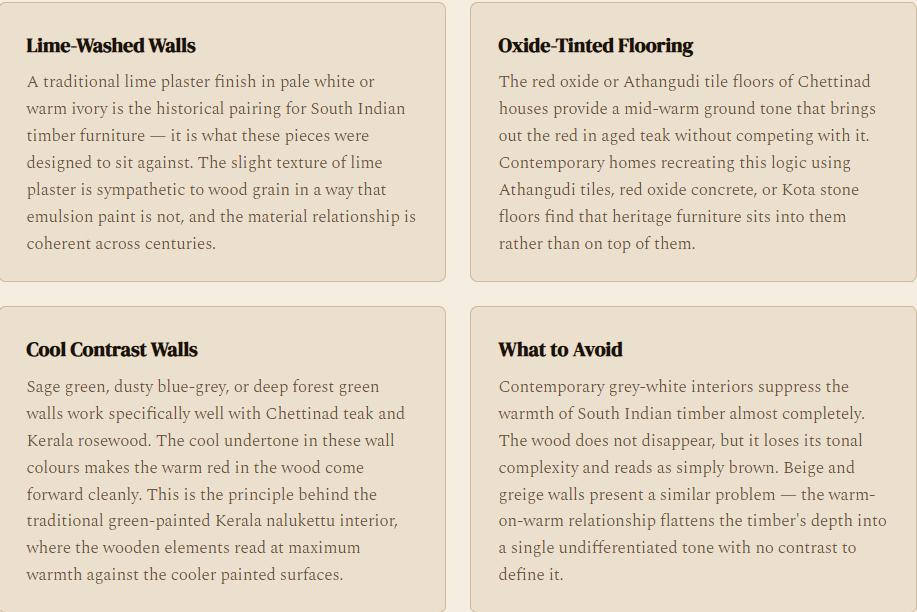
The colour palette of South Indian heritage furniture — ranging from the pale gold of neem through the deep red-brown of Chettinad teak to the purple-toned depth of Kerala rosewood — is warm without being amber in the Scandinavian teak sense. It carries a redness, a depth, and sometimes a darkness that requires different wall and floor decisions than the honey-toned woods of North Indian furniture traditions.
The Climate Argument, Restated for Today
There is a design circularity worth noting. South Indian heritage furniture was developed for the climate conditions of the region: high humidity in Kerala, extreme dry heat in Chettinad’s summer, the coastal salt air of the Tamil Nadu coastline. Contemporary sustainable home design in South India is increasingly working toward buildings that manage these same climate conditions passively — through cross-ventilation, high ceilings, deep verandas, and materials that absorb and release heat slowly. The furniture traditions that developed for those buildings are, in a literal sense, the correct furniture for those buildings.
A low-profile rosewood table in a Kerala house with high ceilings and monsoon cross-ventilation is not a heritage statement. It is the ergonomically and thermally appropriate furniture for that specific spatial and climatic context. The tradition’s return to contemporary practice is not purely cultural — it is functional. The furniture was built for this climate, and the climate has not changed.
These three traditions built furniture for people who intended to stay. That intention is visible in every joint, every carved panel, every piece of Burmese teak that has survived a century of monsoons without complaint.
Chettinad, Kerala, and Tamil Nadu represent three distinct answers to the same fundamental question: what should a domestic interior feel like for people living in this specific place, under these specific conditions, with these specific social and ritual requirements? The furniture that came out of each answer is not interchangeable, and the design intelligence embedded in each tradition is not decorative. It is the accumulated result of generations of makers working with real materials in real climatic conditions for real users.
Contemporary homes in South India that engage seriously with these traditions — not as period rooms, not as museum installations, but as living material culture adapted to current spatial contexts — are building on a design base that took centuries to develop. A carved Kerala settle in a renovated Chennai apartment, a reclaimed Chettinad door panel in a Kochi house, a Thanjavur brass-inlaid cabinet in a contemporary Coimbatore study — these are not anomalies in modern rooms. They are the material logic of the region, finally being given the space it always deserved.